
(AfroGamers.com) The strongest asset in Square Enix’s flagship role playing series has never been its airships, its summon animations, or its willingness to end the world halfway through a campaign. It has always been the ensemble. For much of its nearly four decade history, the series earned its reputation by assembling a roster where every member carried mechanical purpose alongside narrative weight, and where losing any of them changed how a fight actually played out. Recent installments have quietly walked away from that principle, narrowing the experience around a solitary protagonist while everyone standing beside him gets reduced to scenery, and the cost of that decision becomes obvious the second a battle begins.
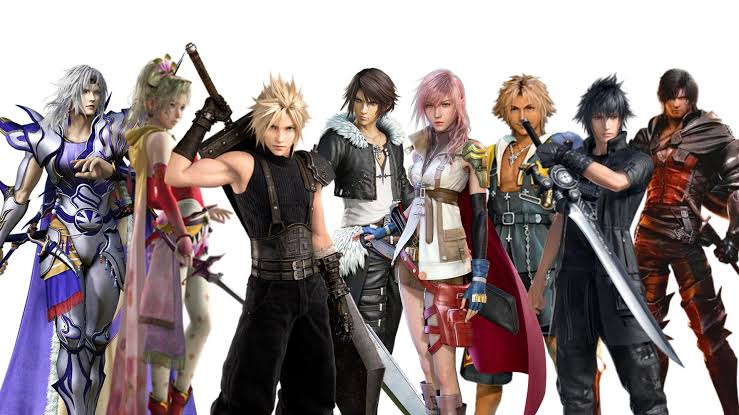
Now let me talk to y’all like folks instead of like a press release.
I came up on a beat up SNES that lived under a milk crate in my grandmother’s den. Blanket over the window, sun beating outside, controller cord stretched across the carpet like a tripwire. What kept me in that room for months at a stretch was not the graphics. It was the crew. Fourteen playable folks in FF6, and every last one of them had a reason to exist. Sabin threw suplexes at a locomotive. Cyan swung a sword with a menu that made you hold your breath through four levels of stance. Edgar carried a toolbox like a mechanic who moonlighted as royalty. Gau ran wild on the Veldt learning moves off monsters nobody else could touch. Setzer gambled with slot reels that could either erase a boss or blow up your whole squad.
That roster was a posse cut. Everybody got a verse, everybody had a flow you could pick out blindfolded, and nobody was riding on somebody else’s beat.
Compare that to what the publisher has been handing us lately and something feels hollowed out.
Older entries built their emotional weight on the idea that a group of broken people had to lean on each other. FF4 practically ran on that engine. Allies joined, allies betrayed you, some got yanked off the board at the worst possible moment. Palom and Porom turning to stone still stings decades later because those twins were mechanically useful and annoying and lovable all at once. Losing them cost you real damage output. Grief and strategy hit at the same time, which is a trick very few games pull off.
FF9 did it differently but just as well. Vivi was a walking existential crisis wrapped in a hat too big for his head, and he also happened to be the reason you survived certain fights. Steiner started as a joke, a stubborn tin can yelling about protocol, then evolved into a wall you actually needed. Freya carried a whole tragedy on her back while jumping halfway off the screen. Quina ate enemies. Amarant sulked in the corner and threw things. Eight permanent party members, eight distinct rhythms, one story that felt like a found family instead of a solo tour with backup dancers.
Ten had my favorite version of this. That swap system where anyone on the bench could tag into an active turn meant benching somebody was never permanent. Lulu, Wakka, Kimahri, all of them stayed relevant to the final hour because the system refused to allow you to forget they existed. Blitzball nonsense aside, Wakka’s accuracy made him the reliable answer to flying enemies my sword users kept missing. Auron broke armor. Rikku stole and mixed. You learned every kid on that pilgrimage because the combat forced an introduction.
Somewhere along the way that philosophy got traded for something sleeker and lonelier.
Fifteen gave us four boys in a car and a soundtrack that made you cry in a gas station parking lot. Genuine love for Prompto, Gladio, and Ignis over here. Problem is, at launch, you directly controlled only Noctis. The homies fought under AI control, while most of your direct input came through their Techniques and cutscene warmth. Square eventually added full character switching in December 2017, a little over a year after launch, which tells you exactly where that feature sat on the original priority list. A brotherhood tale where you can only ever be one brother is a strange contradiction to build a sixty hour campaign around.
Sixteen went further and made Clive Rosfield the only human character under direct player control. Jill shows up in your camp with a whole tragic history and fights beside him, but never once takes a turn under your command. Torgal the dog gets more direct input from the player than most of the humans. Yes, the wolf is a good boy. Yes, I petted him every chance the prompt appeared. That does not replace a lineup.
Here is where I have to be fair, because I do not do the thing where fans pretend a good game is a bad one just to win an argument.
Sixteen’s combat is excellent. Combat director Ryota Suzuki brought experience from Capcom titles including Devil May Cry 5 and Dragon’s Dogma, helping shape something with genuine weight and precise timing, and those Eikon fights are the most spectacular set pieces the series has ever produced. Titan alone justifies the purchase. Clive’s arc about branded slaves and stolen agency is the sharpest political writing Square has attempted in years, and centering him serves that theme deliberately. A story about one man refusing to be a tool for other people’s power arguably needs a narrow lens.
Real time brawling also carries technical constraints. Steering four bodies at once creates chaos that turn based systems handled gracefully and twitch systems generally do not. Design teams face actual tradeoffs, not laziness.
But the excuse only stretches so far, because the counterargument came from inside the same company.
Remake and Rebirth run on real time action and hand you three characters to flip between mid swing. Barret tanks. Tifa builds pressure with speed. Aerith zones the field with wards. Yuffie throws that star and changes her ninjutsu element to exploit weaknesses. Red XIII builds vengeance gauge off blocking. Switching feels like changing instruments in the middle of a song, and the fights ask you to do it constantly. Rebirth even added synergy abilities that only trigger when two teammates coordinate. Somebody in that studio clearly believes an ensemble can survive a modern battle system.
Meanwhile the rest of the genre kept the faith without breaking a sweat. Metaphor ReFantazio gave us archetypes and a crew you build relationships with. Persona 5 built an entire second layer out of confidants. Baldur’s Gate 3 sold millions on companions so specific that people argue about them like family members at a cookout. Octopath split its narrative eight ways on purpose. Nobody told those developers that audiences only want one guy.
Why does this matter beyond mechanics? Because ensemble storytelling reflects something true.
Nobody I grew up around got by without help. Church mothers, uncles who fixed cars in the driveway, cousins who fed everybody, the neighbor who kept an eye on your door. Survival was rarely a solo act, and stories that pretend otherwise ring false to anybody raised inside a real community. The old rosters modeled interdependence. Your mage covered what your fighter could not. Your healer kept the whole operation breathing. Somebody had to draw aggro so somebody else could set up the kill. That is not just game design, that is Sunday dinner logic applied to dragons.
A single chosen one carving through everything by himself is a different premise with different values baked in. Sometimes that story is worth telling. Told exclusively, it starts feeling like the franchise forgot what made people fall in love with it.
So what do I want from the next numbered Final Fantasy?
Give me four bodies I control. Give me a healer whose absence I feel immediately. Let somebody leave the roster halfway through the run and let it hurt because I built around them. Bring back mechanical identity so distinct that I can name a character by their menu alone. Keep the flashy action, keep the production values, keep the orchestral swell when a summon lands. Just remember that the reason people still hum Terra’s theme thirty years later is that she was surrounded by folks who mattered.
Square knows how to do this. They wrote the manual. The Final Fantasy VII remake project and Square Enix’s Octopath games have already proved that ensemble driven RPG design still works on modern hardware.
Put the band back together. I am tired of listening to a solo.
Staff Writer; Jay Baker
An older blerd with a lifelong love for anime, comics, manga, and gaming… Writing for fans who still believe great stories can come from a screen, a page, or a controller…
He can be contacted at JayBaker@AfroGamers.com.