
(AfroGamers.com) There is a quiet blasphemy I have carried for years, and it feels like time to say it plainly. Not every great manga deserves an anime. A portion of the finest work our medium has produced was engineered for paper and paper alone, tuned so precisely to the act of reading that setting it in motion chips away at the exact quality that made it worth loving. We rarely admit this. The culture has trained us to treat a green light as the highest honor a story can receive, the moment it finally arrives.
I understand the reflex. As readers we spend years praying our favorites get picked up, refreshing announcements, arguing over which studio would do the material justice. Yet somewhere in all that longing we skipped a harder question. There is a real difference between a story that wants to move and a story that only works because it holds still, and confusing the two has cost us more than the community likes to acknowledge.
Think about how you read a book like Vagabond. Takehiko Inoue is not drawing pictures so much as painting with ink, leaving whole stretches of white where a weaker artist would cram in noise. You reach a spread of Musashi standing in a field, blade lowered, and the panel just stops. You stop. Your eye wanders the brushwork, the bend of the grass, the weight sitting in the man’s shoulders. That pause belongs to you. You own it. You decide it lasts three seconds or thirty. Hand that same moment to a director and a clock starts ticking that was never meant to exist. A camera drifts, a score swells, and the choice you were making with your own two eyes gets made for you.
That is the part few want to admit. The gutter, that little gap between one box and the next, is where your brain does its finest work. Scott McCloud named it closure, the way we fill that space with our own imagination. A fighter swings in one frame and connects in the next, and your mind builds the whole arc of the blow. Motion erases that labor. It shows you every inch, spells out the entire swing, and in doing so it lifts the pencil right out of your grip. You slide from co author to spectator.
Now let Junji Ito into the room. His horror does not chase you. It waits. A spiral carved into skin, a face sliding into a wall, a figure standing too still at the far end of a hallway. The dread lives in the frozen frame, in the fact that it cannot move, because somewhere in your gut you know it should be moving and it refuses. Every effort to animate his work has tripped over the same wall. Once the picture starts wriggling, the wrongness leaks out. The thing you feared shrinks into a thing you simply watch. Uzumaki in print is a slow rot behind your ribs. On a screen it becomes a monster reel, and monsters we can handle. It is the stillness we cannot.
Silence is the other casualty, and a heavy one. Inio Asano built Goodnight Punpun around wordless pages, around a small cartoon bird drifting through a life too heavy for language. You turn to a spread and there is nothing, just a figure sitting in a room, and that emptiness says more than any speech could. Now put a voice in that room. Add a piano. The hush suddenly has a score behind it, and a hush wearing a score is only mood in a costume. Mood is fine. It is simply a different creature from the raw quiet Asano trapped in those frames.
I keep circling this idea that the reader runs the tempo. A comic hands you the throttle. You tear through the loud stretches and crawl through the tender ones. A series cannot offer that. It has a runtime, a budget, an opening theme that must land at a certain mark. Tsutomu Nihei’s Blame! makes a fine witness for the prosecution. That book is mostly emptiness, corridors stretching past reason, a lone man dwarfed by structures so massive they feel like a lie. The scale unsettles because you feel small holding it in your hands. Squeeze all of that into a film and the vastness becomes a set piece. A number. Something a computer rendered one weekend. The awe drains straight out through the bottom of the screen.
And here is a smaller thing that matters more than most folks expect. Much of this art was drawn to live in black and white. The absence of color is not a limitation the artist was suffering under, waiting on a studio to come rescue it. It is a decision, a whole grammar of its own. Slap a palette across Inoue’s ink and you have not upgraded a thing. You have translated a poem into a language that lacks the one word it needed most.
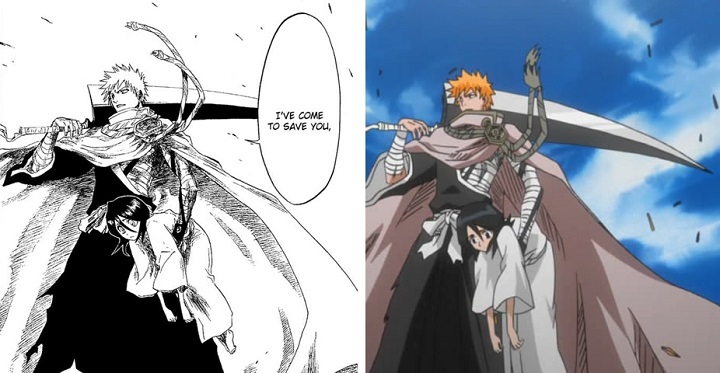
Let me be fair, because a blerd who cannot hold two thoughts at once is just a hater with a bigger vocabulary. Plenty of these books get better under the lights. A Silent Voice bloomed at Kyoto Animation, all soft edges and trembling water. Vinland Saga found new muscle in motion. Frieren turned patience into something you could sit inside for twenty minutes and never check the clock. So the claim is not that studios wreck everything they touch. That would be lazy and untrue. The point is narrower, and I think sharper. Certain works are married to the print in a way no budget can undo. The paper is not a container for the story. The paper is the story.
There is a trap to sidestep here too. I am not preaching that reading is holy and watching is for kids. That take is corny and it is wrong. What I am telling you is that these are two separate languages, and translation always costs something. Once in a while the cost is tiny and the reward enormous. Other times it walks off with the entire soul of the thing. A person who loves a work should be able to feel that difference instead of applauding every adaptation like its mere existence is a gift dropped from heaven.
So ask yourself something simple the next time the community begs for a green light. What does this book do that only ink can do? If the answer is spectacle, big fights, wild worlds, sweeping color, then let it fly. Cartoons were practically invented for that. But if the answer is stillness, or a held breath, or the specific gravity of one drawing you could stare at until it burned into memory, then let it be. A love like that is better left uncontacted. Certain volumes were built to sit in your hands, close and private, moving at exactly the speed of you.
We treat every adaptation like a promotion, as if the book was just a lobby you sat in while the real thing got ready. Flip that. That paper was never a rough draft. For a handful of these masters it was the finished cathedral, and pointing a camera at a cathedral does not make it holier. It only proves you showed up. So the next time somebody asks why your favorite never got a series, smile a little. It may have dodged a bullet. Odds are it stayed exactly what it was always meant to be, sitting on your shelf, waiting for the one kind of motion it ever needed, which was you, turning the page.
Staff Writer; Greg Tucker
GT is an old-school blerd who loves anime, comics, manga, video games, and collecting indie Black comic books.
Contact him at: GregT@AfroGamers.com.