
(AfroGamers.com) Ask most people to describe Major Motoko Kusanagi and you will hear about a woman who barely blinks. That image has held for more than thirty years. Then this past July a new series dropped on Prime Video and made it pretty plain that we settled on the wrong Motoko.
Let me back up, because I already hear the pushback from folks who grew up treating the 1995 movie like scripture. And yeah, I get it. Mamoru Oshii took Masamune Shirow’s cyberpunk source and turned it into a cold, gorgeous meditation on what a soul even is once your body becomes hardware anybody can buy off a shelf. The rain. Those synths. That choir wailing while our girl plummets off a skyscraper into thermoptic camouflage. It lives in me too. The Wachowskis studied it. James Cameron praised it. A whole lot of what mainstream America pictures when it hears the words cyberpunk anime trickled down from that single picture. So no shade toward the director. He built a masterpiece.
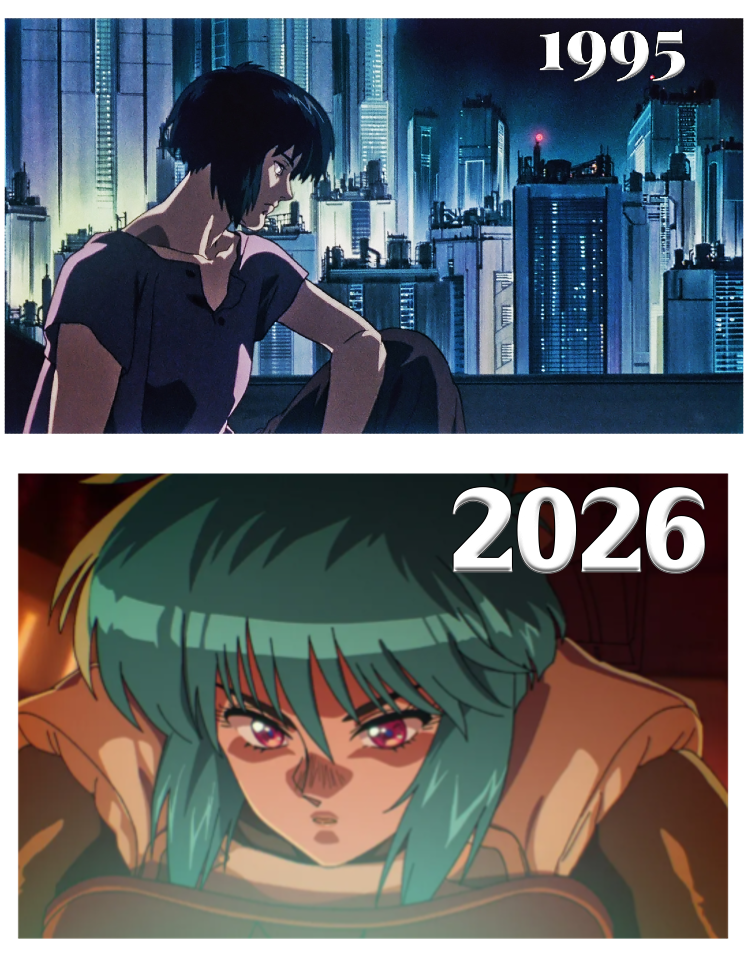
Here is the part I have been sitting with, though. That masterpiece was never really Shirow’s story. It played more like a philosophy seminar wearing the tale’s skin.
Oshii grabbed a single thread out of the comic, the Puppet Master arc, and pulled it tight until nearly everything playful fell away. He made Motoko brooding. Monotone. Androgynous. Beautiful the way a marble statue is beautiful, which means you admire it from across the room and it never cracks a smile back. For most of us over here, that became the character. That flat cool was her entire personality. And if you mainly met her through that film, or even through the more restrained Motoko of Stand Alone Complex, you have still been watching versions that dialed back some of the wild personality Shirow originally put on paper.
Because the person in those original pages? Different animal entirely.
Shirow’s Kusanagi grins. Our girl talks slick to her coworkers, cracks jokes mid mission, pokes her tongue out, lets her face blow up into big rubbery expressions when somebody annoys her. She stays mischievous. Kind of a menace, honestly, in the most affectionate sense. The books get goofy. They get horny. Their author keeps stopping his own action scenes to scribble footnotes in the margins about how his made up tech supposedly functions, the way a teacher grabs the marker when nobody asked him to. So no, this is not a somber tone poem. It plays closer to hanging out with your smartest, weirdest friends, the ones cracking jokes between firefights while holding submachine guns.
Now Science SARU, the studio behind Devilman Crybaby and Dan Da Dan, has decided Masamune Shirow’s original vision deserves its shot on screen. Directed by Mokochan, scripted by novelist Toh EnJoe, with designs from Shuhei Handa, the fresh run premiered July 7 on the Kansai TV and Fuji TV network in Japan while Prime Video rolled it out internationally. Shirow himself described the project as potentially the first installment of a second generation for the franchise, while the people making it have been unusually direct about returning to his manga as their foundation. When a production goes that far out of its way to point back toward the man who created this world, I am listening.
You can feel that fidelity in the choices. Everything looks softer, rounder, more cartoon than the photoreal grit of ’95. Kusanagi’s face moves now. It emotes. Her tongue shoots out when the moment calls for it. Even the tanks changed. Remember those chatty blue Tachikoma from Stand Alone Complex that everybody fell in love with? SARU reached past all of them, back to the roots, and dug up the red Fuchikoma, the original spider machines, complete with a little cat grin when they shrink into chibi mode. None of that is empty fan service. It is a studio saying we read the actual books, and we are building straight from those.
I will not pretend the shift has not rattled people. Scroll the timeline and you will find longtime heads baffled, calling the tone goofy, complaining it feels too loose, too horny, too far from the sacred austere thing they memorized on VHS. And I understand the whiplash. If your entire relationship with this world rests on a single solemn 1995 classic, watching the Major clown around does feel like somebody swapped your serious cyberpunk oracle for a comedy protagonist. Yet that reaction has the history flipped. The loose, funny, expressive Motoko is not the deviation. She is the origin. Oshii’s ice queen was the remix.
What screen only fans have been missing, then, is basically half the character. The warmth counts. So does the humor. Notice how the author let a woman debate the nature of consciousness in a single panel and then rib her teammate about his love life in the next, treating both registers as equally human rather than picking a lane and canonizing it. The ’95 telling asked whether a manufactured soul can be real. That question is gorgeous and I will defend it forever. Yet the answer sat baked into how the source drew her the whole time: she is real because she jokes, flirts, gets petty, gets curious, feels the full spread. Personhood proven in her personality, not just declared in monologue.
There is a deeper win here too, and it comes down to timing. Shirow dreamed up brain implants wired to the open internet, ghosts that survive the swap out of flesh, and machine intelligence drifting toward something like a reproductive drive back when all of it sat in pure speculation. In 2026 those ideas do not feel nearly as distant. We have brain interface research moving into human trials, serious debates about AI consciousness and machine welfare, and growing arguments over what legal status advanced artificial systems might someday deserve. Adapting the fuller, messier, more curious source right now lets the story land as something you could read as current science fiction instead of a prophecy we are supposed to bow toward. The ’95 vision froze the material in amber. SARU thawed it back out and aimed it at the present.
Does any of this dethrone the older movie? Nah. Keep loving it. Put it on tonight, it still slaps, that ending still hits like a truck. Two things can be true at once. Oshii made an incredible film that happens to be a loose interpretation, and this reboot may be the closest anybody has come to putting Shirow’s original vision in motion. One version is a stunning cover. The other is finally playing the song much closer to the way the writer first put it on the page.
So if the lone Major you know is the one staring off into the rain, never quite smiling, do yourself a favor and go meet the woman her creator actually drew. She is funnier than anybody warned you. The legend sanded off a warmth that turned out to be a huge part of her appeal. She has sat almost forty years now, waiting on a screen willing to let her be fully herself. Nobody had to reinvent a thing to get there. They just picked up the original and finally believed it.
Staff Writer; Jay Baker
An older blerd with a lifelong love for anime, comics, manga, and gaming… Writing for fans who still believe great stories can come from a screen, a page, or a controller…
He can be contacted at JayBaker@AfroGamers.com.