
(AfroGamers.com) Every couple months the timeline catches fire over the newest seasonal darling, and honestly, I feel the hype. But scroll past all that gloss and you hit a graveyard of forgotten greatness, discs and tapes that once ruled the racks at Suncoast and the back wall of Blockbuster. The next wave coming up deserves a proper introduction to the anime that shaped the rest of us. So pull up a chair. Consider this a short field guide to the ones that fell through the cracks, not the household names your feed won’t shut up about.
First up, The Vision of Escaflowne. Try describing the plot out loud and you’ll sound unwell. A high school girl lands in another realm, giant armored war machines clank across battlefields, tarot cards decide fate, and a love triangle simmers under the whole thing. Somehow it all fuses into something graceful. Yoko Kanno and Hajime Mizoguchi scored it, so the music alone will rearrange your chest. Van and Hitomi’s relationship actually works because the writers give it room to grow instead of forcing the issue. Those mecha though. Big ornate slabs of armor with blades tucked in weird places, and I could stare at them all day. What grabs me is the mood swings. One episode a schoolgirl is sweating over some boy. The next, a whole kingdom turns to ash. Both land. Half the new shows chasing that kind of range just faceplant. If you came up on isekai, do yourself a solid and see where a lot of your favorite tropes first found their spine.
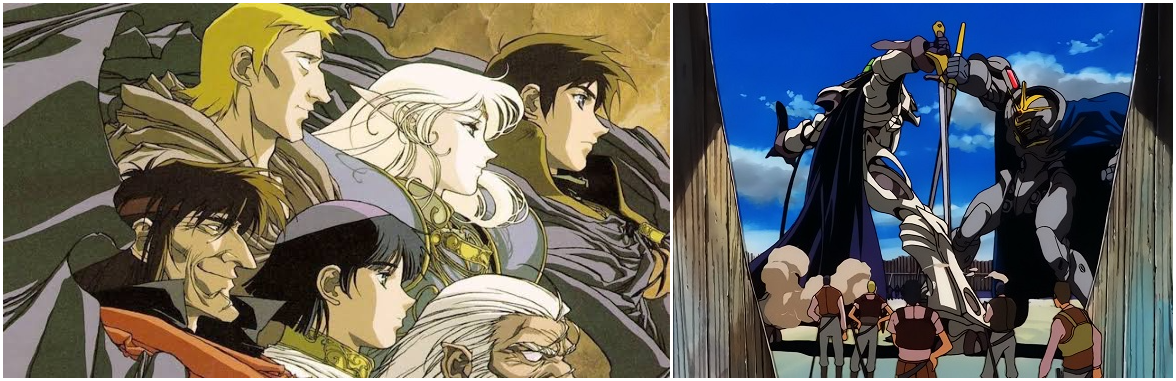
Record of Lodoss War is old-fashioned high fantasy, no apologies offered. It moves like a tabletop session somebody finally bothered to animate, every quest beat and party squabble left in. Parn the earnest young swordsman, Deedlit the elf who launched a thousand crushes, dwarves and dark sorcery and a continent soaked in old grudges. This 1990 saga laid tracks that every fantasy quest you love still rides. Every pointy-eared archer and stoic knight who came after owes a nod to this cast. Slow burn, sure, but the payoff lands with real weight. If your idea of the genre stops at flashy tournament arcs, sit with this one and feel the roots.
Gunsmith Cats drops you straight onto the cold streets of Chicago. Rally Vincent runs a gun shop by day and chases bounties for extra cash, her tiny partner Minnie May lobbing grenades like she’s handing out candy. Kenichi Sonoda knew his weapons cold, and the firearms are handled with a level of mechanical detail most anime never bothered with. Setting the entire thing on American soil handed it a flavor most of its peers never touched. Car chases tear through the Loop with a crunch modern action wishes it had. It stays lean and mean, proof that a tight thriller needs no glowing sword and no chosen savior, only raw skill and steady nerve behind the wheel. Three episodes, no filler, all momentum.
Cyberpunk heads keep sleeping on Bubblegum Crisis, and that’s a crime. Mega Tokyo after the quake, rogue androids, a shady corporation, and four women in powered hardsuits handling business the cops cannot touch. The Knight Sabers carry the swagger of a rock band, and Priss is literally the frontwoman of one. Rain-slicked neon, chrome, and a score drenched in that fat ’80s synth, all of it clearly staring straight at Blade Runner while carving its own lane. Each entry runs as its own tense little mission, easy to sample before you sink in deep. Half of today’s sleek sci-fi is still cribbing this rain and chrome, whether the artists cop to it or not.
Now for something that pokes fun at the whole space opera racket, meet Irresponsible Captain Tylor. Justy Ueki Tylor somehow ends up commanding a warship, and the running gag is that you never quite know if the man is a genius or the luckiest idiot alive. The humor plays it dead straight. It keeps jabbing at all that chest-thumping space-navy melodrama, and half the fun is arguing with yourself over whether Tylor planned his latest miracle or tripped face-first into it. His crew earns their keep too, a bunch of burnt-out officers and two troublemaking twins who milk every scene. Underneath the jokes sits a surprisingly warm meditation on leadership. Folks tired of grimdark posturing will find this goofy commander weirdly refreshing.
Blue Seed pulls from Japanese myth in a way few others bothered to try. Momiji, a regular teen, learns she belongs to the ancient Kushinada bloodline and becomes central to the fight against the Aragami, supernatural creatures rooted in Japanese mythology. Susano-o, mitama, the entire Shinto mythos gets pulled into a monster of the week groove that never loses its emotional core. Its ’90s production means the color palette pops with a hand-painted cel warmth phones cannot fake. It mashes horror and romance into old folklore without losing the thread, and the finish more than earns its payoff.
Golden Boy is the oddest pick on here, and I’m not backing down from it. Kintaro Oe travels town to town on a rickety bicycle, taking odd jobs and soaking up a new skill at each one. Fair warning, it gets crude. And I mean crude. But sit with it and you find a guy chasing knowledge like his life depends on it, tripping over his own feet, dusting off, going again. The art earns its own paragraph. When Kintaro flips out, his face contorts into these deranged, hyper-detailed expressions that still hold up as some of the best hand-drawn comedy around. Dude studies. Dude fails. Dude climbs back on the bike. There is a strange nobility to a knucklehead who keeps chasing knowledge for its own sake.
A lot of older anime got unlucky with the business side over the years. Licensing deals expired, smaller distributors disappeared, and plenty of titles became difficult to find during the long shift from physical media to streaming. Kids coming up in that gap sometimes had almost no honest way to watch certain shows, short of hunting down aging discs or hoping another distributor eventually rescued the rights. Some of these titles have since resurfaced through Blu-ray reissues and official streaming services, while others remain harder to track down. That silence was never a verdict on quality. The market simply lost the thread for a while, and a whole shelf of treasure went quiet with it.
So why does any of this matter for a crowd raised on simulcast and endless recommendation queues? Because taste gets shallow when the pool only goes back three years. These older anime were built by hand in an era with tighter budgets and zero safety nets, which forced true invention. Limits breed creativity, and those teams had them stacked to the ceiling, which is exactly why the swings read so bold. You can spot the seams, sure, but you can also spot the ambition. Nobody was optimizing for a thumbnail. They were trying to move you, and that effort still radiates off the screen decades later.
Passing this down feels less like homework and more like handing a cousin the good headphones. You want them to hear what you heard. Half the joy of loving a thing is watching fresh eyes light up over it years later. The catalog is out there on Blu-ray reissues, in a few streaming corners, and yeah, in the dustier reaches of the internet if you know where to dig.
Do the youngbloods a favor. Slide one of these into rotation next movie night. Kill the algorithm for one night. Put on something with a little age on it and let it catch you off guard. The classics did not fade because the calendar rolled over. The world just looked away for a minute. They went quiet, waiting on somebody to press play. You will not regret the detour. Trust me.
Staff Writer; Greg Tucker
GT is an old-school blerd who loves anime, comics, manga, video games, and collecting indie Black comic books.
Contact him at: GregT@AfroGamers.com.