
(AfroGamers.com) The cowboy America fell for was a lie of omission. Not the whole lie, just the convenient parts. Hollywood handed down John Wayne and a territory scrubbed spotless, when the real country got built in large part by folks who never made the poster. Historians estimate roughly 1 in 4 cowboys working the cattle trails were Black. You would never guess that from a century of Saturday matinees.
So it reads as more than a correction when Netflix rolls out a gunslinger on November 3 who was flesh and blood long before he was ever a cartoon.
Bass X Machina is the kind of swing you take only when you have something to prove. Studio Mir, the South Korean house behind The Legend of Korra and Devil May Cry, runs the animation. LeSean Thomas created this one, same as he did Cannon Busters and Yasuke, so the pedigree is not in question. Brian Tyree Henry, an Oscar and Emmy nominee, voices the lead while serving as a producer. Every episode drops at once. No weekly wait, no stretching the suspense across two months. Netflix clearly wants folks to binge the whole thing and start fighting about it before anyone’s had a chance to cool off.
The setup is simple, but it carries weight. You take one of the wildest real lives the 1800s ever produced and drop him into a busted, retrofuturist version of the frontier. Outlaws everywhere. Machines built for war. And something worse than either, waiting in the dark.
Now here is what most people never learned in school. He actually existed. Bass Reeves walked this earth, and the facts of his life beat most of what a writer would dare invent.
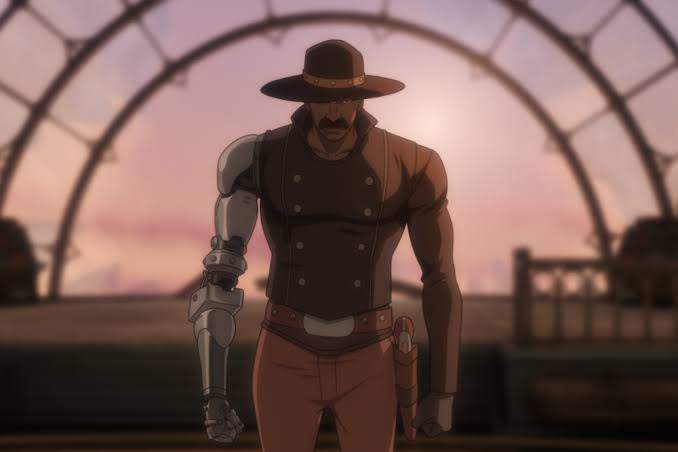
He was born into slavery in Arkansas, somewhere around 1838. When the war broke out, accounts say he seized his chance to escape, disappearing into Indian Territory for years. He lived among Native communities, learning the languages and customs of several tribes. Their ways stopped being foreign to him after a while. So did the country itself, every creek bed and low rise committed to memory, because out there a man who did not know exactly where he stood did not last.
Judge Isaac Parker needed deputies with the nerve to cross into the badlands past Fort Smith and ride back out alive. Reeves fit. A Black man carrying that badge and that much authority west of the Mississippi was close to unheard of at the time.
Then you get to the numbers, and they sound made up. Reeves reportedly made over 3,000 arrests during his career, though historians caution that the exact total remains difficult to verify. Decades on the job. He could shoot straight with either hand, walking out of more gunfights than anyone could count without ever catching a bullet. Disguise was his favorite trick. Sometimes Reeves showed up in an outlaw camp dressed as some busted saddle bum or a passing preacher. The wanted man rarely recognized the lawman until the cuffs were already on. One warrant had his own son’s name on it. He served it anyway. You will also hear that the Lone Ranger got borrowed from his story, a theory nobody has ever nailed down for certain. Does not much matter which way that one falls. The fictional cowboy in a white hat became a household name, while the country filed the actual human being under forgotten, on purpose.
That erasure is what this story keeps poking at. The deck was stacked against him twice over.
Here is what Thomas seems to understand in his bones. You do not honor a life like that with some solemn, museum quiet biopic. You crank the volume. His vision mashes anime into the old cowboy picture, running the whole mess through a punk amp. The teaser plays that out. Boiler steam, brass fittings, a blade meeting a six shooter, and a hero who moves like he made peace with his own funeral a while back. It looks like a tribute with the volume knob snapped off, and you watch thirty seconds and nod.
The voice work goes deep on talent. Tati Gabrielle carries an edge she has sharpened across film sets and game booths. Cree Summer shows up too, and her voice basically raised a generation of kids without most of them realizing it. Janelle Monáe does double duty, voicing Glory and performing the original theme song, “Honor Killing,” the kind of extra mile that tells you nobody on this project was phoning it in.
Step back far enough and you can see the pattern Thomas has been laying brick by brick. An android who looked like a young Black girl drove the anime road trip in Cannon Busters. An African samurai, pulled from a real historical man, anchored Yasuke inside feudal Japan. This makes three. One quiet argument stated three different ways: a form that Black viewers have loved for ages while rarely catching their own reflection in it, finally handing the spotlight to faces that match the crowd.
Animation built for grown people fits this story like a tailored coat. The deputy walked through blood and gray choices during a brutal stretch of history. Any version softened for the whole family would have to lie about half of it. Keep the violence honest, leave the morality tangled, and you get a lead heavy enough for prestige drama, minus the live action price tag. Ink and paint can follow a soul anywhere a mind can picture.
Underneath all the gunsmoke sits a heavier question about who gets to become myth in the first place. That old frontier formula was never just entertainment. It whispered to the whole country about who counted as a hero, whose dirt was free for the taking, whose days rose to the level of something worth retelling. The guest list stayed short for about a hundred years. Blue Eye Samurai cracked that door recently, pulling an overlooked perspective into the light through striking animation, and this show walks through the same opening wearing different boots.
The strange machinery is doing real work too, not just looking cool. Brass gears and patched together contraptions turn the backdrop into a question with teeth. What is left of a man’s soul once every gear around him was bolted together to break him? Hang a badge on him and the whole thing twists tighter, since the nation that handed him that authority had only recently stopped allowing men to claim him as property.
Everything hangs on one bet: whether the show can hold both halves at the same time without letting either slip. The dumb fun of a sharpshooter cutting down monsters, next to the ache of a figure the real nation worked hard to erase. Stick the landing, and Reeves gets handed the kind of larger than life treatment the frontier myth kept locked away from him. Outsized. Hard to turn away from. Written down to last, not scrawled in something that fades.
November 3. The whole run in one sitting. A legend returned to us, and charging interest.
Staff Writer; Greg Tucker
GT is an old-school blerd who loves anime, comics, manga, video games, and collecting indie Black comic books.
Contact him at: GregT@AfroGamers.com.