
(AfroGamers.com) Something needs saying before we go any deeper: looking good and having a look are two completely different accomplishments, and a heap of anime confuse the first for the second. Pretty is cheap these days. A studio throws budget at the sakuga, hires whichever character designer is hot that season, layers on some soft gradient lighting, and everybody claps. You watch it, you nod, you forget it by dinner. Then a viewer boots up Soul Eater, and suddenly you remember how it feels once a show actually commits to a vision instead of borrowing it.
Picture Death City for a second. Forget realism, there is no sensible skyline anywhere in sight. You get a jagged pile of white towers and blood red roofs dropped into the Nevada desert, the kind of sight that looks like a fever somebody put to paper. Cobblestone streets fold back on each other. Staircases climb toward nowhere in particular. Half the town seems ready to slide sideways the moment you lean on a wall. Atsushi Ohkubo pulled openly from Tim Burton, while the crooked architecture carries the distorted flavor of German expressionism, then he flipped those influences the way a producer flips an old soul record. He kept the crooked bones and built something that knocks.
Sitting on top of all that is Shibusen, the academy, which honestly looks less a school than a haunted funhouse dared into existence. Black spires. Conical crimson caps. Giant candles jutting out of the walls that burn forever without shrinking, which makes zero physical sense and I love it for that. Three enormous skulls guard the entrance, the center skewered by red spikes through its eye sockets. Nothing about the place says “come learn here.” Everything about it says the world runs on rules your science teacher never mentioned.
Now about that moon, because good grief, that moon.
A fat yellow crescent hangs over the town. It has a pointed nose and a mouth of teeth frozen into a permanent grin. One crater does the job of an eye, tracking the streets below without a single blink. Blood sometimes leaks through those clenched fangs when the violence and madness below start boiling over. Most shows use a full moon as a lazy mood cue, a way to whisper “spooky” without doing any work. The mangaka turned his into a personality, a leering witness that laughs at its own private joke while children fight monsters below. Up in daylight the sun wears the same nasty grin, spitting little sunbeams as if chuckling at you personally. Two celestial bodies, both amused, neither on your side. That reads as more than decoration. It is an entire philosophy about madness printed across the sky.
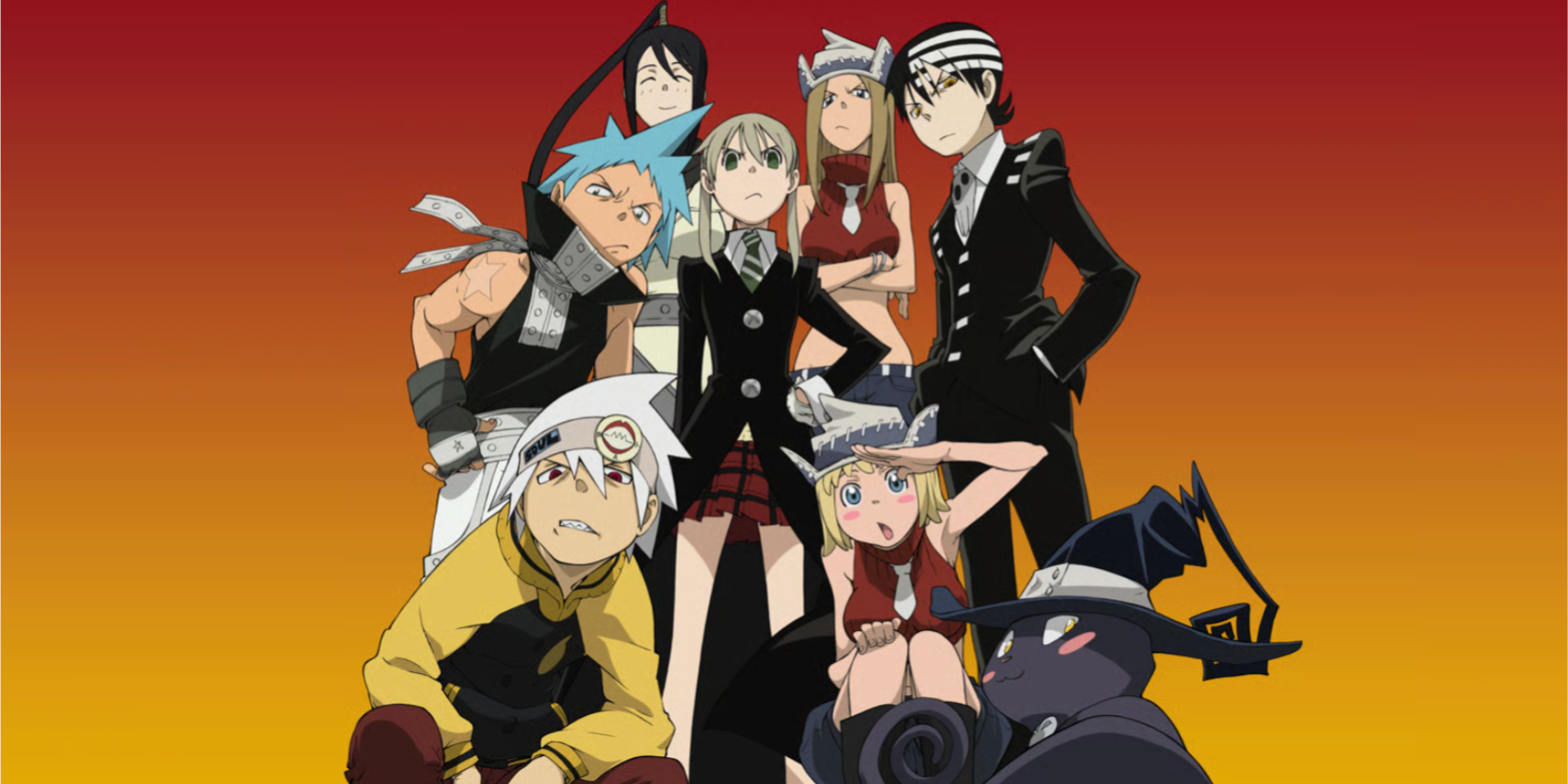
The people walking around underneath match the architecture, thank God, because a normal cast would have looked ridiculous in a place this loud. He builds bodies out of exaggeration. Lanky limbs, geometric faces where a nose is just a shadow and a suggestion, expressions that stretch and contort past anything a real face could manage. Soul flashes a mouth of shark teeth. Black Star struts around drawn as arrogance itself got a growth spurt, all sharp angles and swagger. Maka stays comparatively grounded because someone in the frame has to, and her practical silhouette reads instantly against the chaos surrounding her.
Then there is Death the Kid, my favorite little design flex in the entire production. Dude is a reaper who suffers a crippling obsession with symmetry, and the creator built his entire visual language around that neurosis. Three white Sanzu stripes wrap only the left side of his hair, deliberately unfinished, a lopsided detail that torments the reaper and delights the audience at once. His breakdowns over crooked picture frames become physical comedy, sure, but they also weaponize the art itself. The show tells you who a person is through shape and balance, not just dialogue. His twin pistol partners, Liz and Patty, come with mismatched heights and temperaments so the trio never sits still on screen. Every silhouette does double duty.
Color is where a lesser production would have played it safe, and Bones simply refused. Blacks pool deep across the palette, joined by muted purples and the sickly gold of that grinning sky. Then something cuts through the murk, a shock of bright blue hair or a splash of crimson bleeding into the shot. Bright shades sit inside heavy shadow instead of beside it, so the frame always reads as a costume party photographed at midnight. Wander through any still and the eye knows exactly where to land because the coloring guides it there on purpose. Nothing muddy, nothing accidental.
Music might be the most underrated weapon in the arsenal, and I say that as somebody raised on crates full of vinyl. Taku Iwasaki scored this thing as if he had no interest in what an anime soundtrack was supposed to sound. He fused breakbeat, jazz, orchestral swells, and straight hip hop into a single restless mood that matched the kinetic animation beat for beat. Insert cuts such as “So Scandalous” and “Psychedelic Souljam” bump harder than half the rap on the radio during that stretch. T.M. Revolution came through with “Resonance,” a guitar driven opener that got tattooed onto a generation of fans, and Tommy heavenly6 handed over “Papermoon” for the back half. An urban, moody, unmistakably cool sonic identity glued the visuals together instead of just sitting politely behind them.
Add it all up and you land on the word people always reach for with this property: Halloween. Not the cheap plastic version either. The good kind. Think about the costume party feeling it runs on. Whole neighborhoods sit decorated for the final night of October. The cast looks ready to go trick or treating, and underneath all that fun a quiet dread keeps humming along, too low to actually ruin the party. Plenty of creators borrow a mood like this for an episode or two before handing it back. Bones moved in and never left.
Here is my actual argument, the thing I have been circling this whole time. Plenty of shows are gorgeous. Ufotable will melt your eyeballs with particle effects. Kyoto Animation can make a cup of tea feel sacred. Gorgeous is common now, almost a baseline expectation, and I am grateful for it. Having an identity is rarer and worth far more. Ohkubo and Bones did not simply chase attractive frames. They built a world that runs on its own logic and its own strange gravity, a world with a sense of humor baked right into the brickwork, then dressed every corner until the place felt lived in. Strip off the logo. Cut the dialogue. Hand me a single silent frame with zero context attached, and I could still name this property inside a second.
Most anime look nice. A precious few actually look like themselves. Ohkubo built a grinning, crooked, blood dripping world that nobody has managed to copy, and that stubborn originality is exactly why we keep coming back to it. Style is not a coat of paint. It is a fingerprint. That signature left a smudge on the medium that never wiped clean.
Staff Writer; Jay Baker
An older blerd with a lifelong love for anime, comics, manga, and gaming… Writing for fans who still believe great stories can come from a screen, a page, or a controller…
He can be contacted at JayBaker@AfroGamers.com.