
(AfroGamers.com) Watch enough samurai anime and something starts to stand out. The genre’s best swordsmen usually are not hungry kids clawing toward greatness. They are battle-worn veterans. Men who touched the top of the mountain years ago and walked back down carrying something they still cannot put down. It took me three full runs through Rurouni Kenshin before the idea actually clicked, but once it did, I could not watch these shows any other way. Rookies get training arcs. Weathered warriors get reckonings, and a reckoning is always the better story.
Consider a standard shonen formula for a moment. Our protagonist wants to become the strongest, and everyone watching already knows his destination because we grew up following that exact journey on Toonami and debating power levels at the lunch table. Real comfort lives in that familiarity, no question. But a veteran warrior, one who was once the strongest, who carries bodies in his rearview mirror and a reputation he wishes the world would forget, occupies richer territory. He is asking a question this genre rarely poses out loud. What do you do after a war ends and you realize winning repaired absolutely nothing?
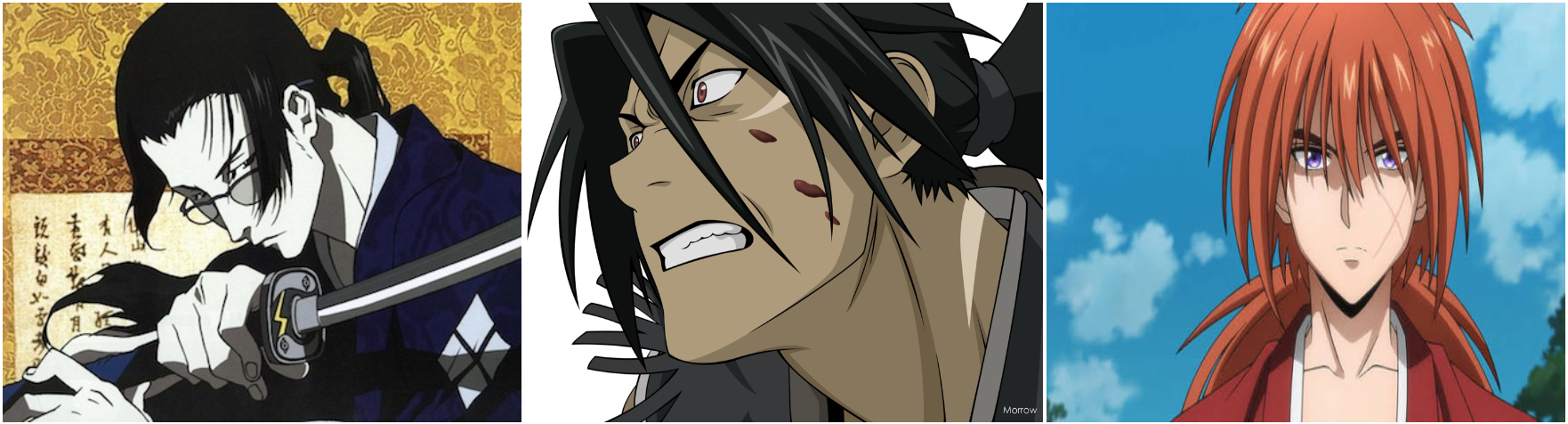
Kenshin Himura is the blueprint. Before all the wandering and the goofy smiles, my guy was the Hitokiri Battousai. Manslayer. A name Kyoto mothers probably used to scare their kids into bed. His blade helped birth a whole new era, and that era turned around and healed exactly none of the damage he did to get there. So what does he do? He carries a sword with the cutting edge forged on the opposite side and spends the next decade drifting around Japan, doing laundry and saying “oro” like somebody’s odd uncle.
Folks really sleep on how radical that choice is. A reverse-blade sword is not merch-table gimmickry. It is one man putting a physical wall between the killer he was and the person he is fighting to become. Whether that wall holds when his past shows up at the door, and it always shows up, is basically the entire series. Then here comes Shishio, burnt and bitter and everything Kenshin could have been, forcing him to protect people without turning back into the weapon the government built.
That tension hits differently than “I want to be Hokage.” That tension is grown folks’ business.
Then you have Nanashi from Sword of the Stranger, and if you have not seen that film, close this article and go handle your business, because the animation alone will make you apologize to your television. Nanashi tied his blade into its sheath. Literally knotted the thing shut. He served under warlords, followed orders he cannot live with, and now refuses to draw steel even when drawing steel would make his life a whole lot easier.
Watching him protect that little boy Kotaro while wrestling with his own vow, that is the movie. The final duel is gorgeous, sure, but it lands because we spent most of the film watching a man beg the universe not to make him be good at the one thing he hates about himself.
Blade of the Immortal takes it even further. Manji cannot die. Sounds like a superpower until you realize immortality for a killer is just an unpayable debt with no due date. His violent past left a hundred samurai dead, including his own sister’s husband, and now he has to kill a thousand evil men to balance the scales.
Except the story keeps whispering the truth underneath all that arterial spray. Scales like that do not balance. Every body dropped creates another grieving family, another person looking for revenge, another promise made over a grave. The cycle feeds itself. Manji knows it too, which is why he moves through the story like a man serving a sentence rather than chasing glory.
And can we talk about Jin from Samurai Champloo for a second? Everybody loves Mugen because Mugen breakdances through sword duels over Nujabes beats, and honestly, valid. Rest in peace to a legend whose production still gets rotation in my headphones.
But Jin is the quiet tragedy of that show. Classically trained, technically perfect, and completely obsolete. His master is dead by his own hand after being ordered to kill him. The school that formed him has been corrupted. The world that gave his skills meaning is slipping away, and he is out here wandering an era that has little use for him except as a hired blade or a corpse.
Jin already lost before episode one started. Watching him slowly find a reason to care again, that is the arc, and the show is smart enough to never announce it.
Even Gintama, wild and unhinged as it is, runs on this engine. Strip away the alien jokes and the fourth-wall demolition, and Gintoki is a veteran of a lost war, eating parfaits and acting foolish while carrying memories he rarely allows himself to discuss. The comedy reads like armor.
When the series drops the jokes and lets him remember Shouyou, the tonal whiplash works precisely because we know the silliness was always covering something deeper. That is a very specific kind of realness. Plenty of us know somebody who laughs the loudest so nobody asks how they are actually doing.
Here is why this archetype resonates so hard with me, and probably with a lot of us who grew up between cultures and code switches. The tired warrior understands consequence. He knows that every conflict, even a righteous one, extracts a tax from the soul, and the receipt never stops printing.
Our communities know this intimately. We know that winning an argument, a case, a battle, whatever, rarely restores what was taken. The damage stays damaged. The dead stay dead. Grief does not check the scoreboard.
So when Kenshin stares at his own hands like they belong to a stranger, or Nanashi refuses to draw the weapon that once defined him, something clicks that goes far beyond fandom. These shows write pain with remarkable honesty, and they often manage it without parking a therapist in the corner to explain everybody’s feelings to the audience.
The young challenger asks, “Can I win?”
The weathered ronin asks, “What will it cost, who pays, and was any of it worth the price the last time?”
One of those questions has a power-scaling wiki answer. The other one follows you into your thirties and sits with you at red lights.
There is a craft reason this works too. When your lead is already dangerous, the writers cannot lean on strength as the stakes. Kenshin will win the duel nine times out of ten. We know this. So the drama has to live somewhere else, in restraint, temptation, and the terrifying possibility that he stops holding back.
The blade becomes a moral instrument instead of a measuring stick. Suspense shifts from “Will he survive?” to “Will he stay himself?” That second question is infinitely more interesting because we all fail it sometimes in smaller ways.
So yeah, keep your prodigies and your tournament brackets. I will be over here with the scars and the ghosts, the men who sheathed their steel not because they got weak but because they finally got wise.
Peace does not arrive when the strongest man wins. Peace arrives when the strongest man decides the whole game was rigged from the jump and quietly walks off the board. That decision, made every single episode, one temptation at a time?
That is the realest arc in anime. Full stop.
Staff Writer; Greg Tucker
GT is an old-school blerd who loves anime, comics, manga, video games, and collecting indie Black comic books.
Contact him at: GregT@AfroGamers.com.