
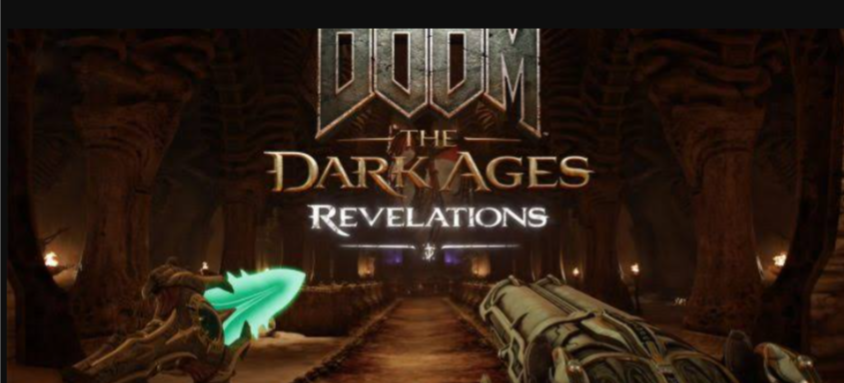
(AfroGamers.com) Nearly fourteen months after id Software asked us to trade speed for weight, the studio has quietly given much of it back. Revelations landed on July 7 carrying a twenty dollar price and a lot more nerve than most post launch content bothers with. Within an hour or so, something becomes obvious. This isn’t a victory lap or a content dump. It’s a correction, and a bold one, because what’s being corrected is the founding thesis of the game it’s bolted onto.
Rewind to May 2025. id came out swinging with a philosophy rather than just a product. Eternal had turned you into a fighter jet, so this one would turn you into a tank. Stand and fight. Plant your feet. Parry the green stuff, bash the little ones, let a shield do the talking. Hugo Martin recited that line in every interview like scripture, and on paper the swerve earned respect. Nobody wants a studio running the same play until the wheels come off.
Here’s what happened in a lot of living rooms, mine included. That tank got boring. Not immediately, mind you. Clanking across a gothic battlefield with a buzzsaw frisbee strapped to your arm felt like nothing else on the market for a good long while. Then arenas began blurring into one another. Then you noticed your movement had been trimmed down to walking, walking slightly faster, and occasionally shoulder checking a fool into a wall. Dodging? Gone. Verticality? Mostly decorative. You were pinned to a horizontal plane, running a very well produced version of the same encounter on loop, and that flow state which made 2020’s outing feel like drumming never quite arrived.
Plenty of folks loved it exactly as built. Genuinely. An audience exists that found Eternal exhausting, that resented being told to swap weapons like a barista taking orders, and for them a slower rhythm came as relief. I respect the position. I’m just not sitting in that pew, and judging by a year of forum arguments, neither are a whole lot of you.
So along comes this frozen purgatory story, and inside the opening level id does something almost cheeky. They break the shield. Betrayal, defeat, the big man dragged down into Hell’s core with his armor in pieces, and the centerpiece of an entire design philosophy gets snatched away from him. Call it a plot beat if you want. I’d call it a confession. Somebody in that building stared at their own signature mechanic and asked who the Slayer becomes without it.
What he becomes is the Chain Spear, and I need you to understand this thing is not a gimmick weapon. It stabs at range. It pierces defenses. It yanks you toward demons and lets you swing or orbit around them, which means the fight is suddenly happening in the air, above you, behind you, and in places the original campaign rarely asked you to use. Reviewers keep reaching for the same comparison because it’s the accurate one. It’s Eternal’s meathook energy welded onto medieval bones. The grapple is back. The dash is back. The pressure is back.
And pressure is the word I want to sit with, because the base campaign’s real sin wasn’t slowness. Slow can be terrifying. Slow can be Resident Evil. The sin was comfort. Once you learned the parry timing, most encounters stopped asking you anything. You were never truly cornered, never scrambling, never doing that thing where you’re at fourteen health, out of ammo, and improvising your way out of a coffin. The expansion puts that back on the menu with intent. New demons show up with actual job descriptions. Archviles summon reinforcements and teleport around like they’ve been holding a grudge since Doom II, which they have. Warlocks buff everything nearby while drowning the arena in fog. Cosmic Elementals harass you from above so planting and swiveling stops being an option. Triage becomes mandatory. Prioritizing becomes mandatory. Moving becomes mandatory.
Difficulty scales up too, and there’s a substantial endgame structure waiting after the credits with Master Arenas, newly opened paths, extra puzzles, additional challenges, and an ultimate boss encounter. Classic DOOM layouts return as rebuilt flashbacks, recreated with modern materials and effects while you’re rocking a shotgun that sounds like 1993. Ten to twelve hours of content, more if you’re the type who has to find every last collectible before you can sleep. Early reviews have been highly positive, although the critic pool remains small, with the difficulty curve and the backtracking heavy endgame structure showing up as the main sticking points rather than the combat itself.
Now the harder question, the one I actually want to argue about.
Should an expansion get credit for correcting the flagship’s biggest weakness?
My honest answer is yes, but with a receipt attached, and the receipt matters.
Give credit, because the alternative is a world where studios never course correct in public. Think about what id had to do here. They spent a year and a full marketing campaign telling everybody that the deliberate, grounded, shield forward approach was the point, the vision, the future. Walking that back in the sequel would have been easy and quiet. Walking it back in paid content nearly fourteen months later, in front of the same people who bought the original argument, takes a certain amount of nerve. Most companies would have doubled down and called the audience wrong. Instead they wrote a story where the Slayer loses the very thing that defined him and has to rebuild into something faster and hungrier. Good marketing doesn’t get you there. Listening does.
Now the receipt. Anybody who bought at launch paid full freight for an incomplete idea, and here comes a request for another twenty dollars to get the version that sings. Nobody in a press release wants to do that math out loud. If the mobility and the aggression are what make the combat sing, and if the developers now agree that they do, then the seventy dollar product was missing something essential and the fix has a price tag on it. You can call that iteration. You can also call it a toll booth.
A version of this argument goes too far, though, and I don’t want to slide into it. Truth is, the new material only lands this hard because of the foundation holding it up. Your spear thrills you partly by contrast. Freedom registers because the weight is still fresh in your hands. Parrying, shield bashing, that heavy footed pulse, all of it remains, load bearing as ever, and swapping back to the saw is one button away. One reviewer over at Gamereactor even argued that the expansion can sometimes feel better with the repaired Shield Saw, despite the extra options offered by the Chain Spear. That suggests the original design was never broken. Just unfinished. Nobody repudiated anything here. They wrote a second draft.
Here’s where it turns grim. Microsoft’s Xbox restructuring hit id Software immediately before this thing shipped. Initial reports said roughly half the studio had been dismissed, while a Texas WARN notice later identified 136 id Software positions, including 96 at the Richardson office and another 40 remote workers who reported to that location. The same notice included 22 additional cuts at Bethesda Game Studios in Austin, with 146 of the 158 affected workers represented by the Communications Workers of America. Best work these folks have done in years, delivered while colleagues packed up desks.
The studio has since pushed back on the framing, saying the reductions were spread across teams and that the crew today runs about the size it did during DOOM 2016, which is either reassurance or corporate throat clearing depending on how much faith you have left. Launch also brought some rough edges, including button binding trouble, minor bugs, and progression problems that prompted an early hotfix. None of that proves the corporate turmoil affected development, but the timing made the problems harder to separate from the uncertainty surrounding the studio. It doesn’t change what’s on screen. It changes how what’s on screen sits with you. Craftsmen at the peak of their powers, rewarded with a pink slip.
So where does that leave us.
If you bounced off the medieval detour last year, come back. Seriously. The complaint you had is the exact thing this content addresses, and it addresses it with more imagination than a patch note ever could. If you loved the original as it was, you’re not being punished either, since the toolkit expands rather than replaces.
But hold both thoughts at once. This is a triumph and an admission. It’s a studio proving they can still cook, and proving the first dish came out under seasoned. Praise them for hearing us. Just don’t let anybody tell you we weren’t right the first time.
Staff Writer; Greg Tucker
GT is an old-school blerd who loves anime, comics, manga, video games, and collecting indie Black comic books.
Contact him at: GregT@AfroGamers.com.