
(AfroGamers.com) It is the year 12,090, give or take. The world went bad on us a long while back. Science got reduced to campfire stories. Out in the ruins, the junk our ancestors left behind still buzzes and sparks. Somebody comes riding across all of it. Wide black hat. A cloak kicking up behind him. His horse is half animal and half machine, which already tells you most of what you need to know about this place. The man barely talks. Doesn’t have to. Catch him in the right light and you see the face hiding under that brim, too lovely for a wasteland, too calm for somebody who so obviously belongs nowhere.
And that rider is exactly why Vampire Hunter D keeps outliving every fad that was supposed to bury it. It first hit screens back in 1985 and somehow it hasn’t aged a day.
Most anime curdles. You go back to it years later and the art looks stiff, the story crawls, whatever scandalized folks at the time barely registers anymore. This one dodges all of that. Hideyuki Kikuchi wrote the novels it springs from, Yoshitaka Amano gave its central character that unforgettable look, and together they made something that flat out refuses to feel dated. Picture a world where a castle gone to ruin sits in the shadow of dead cyborg machinery and nobody around thinks that is strange. Where ancient bloodsuckers lord over crumbling estates powered by lost tech. Where a cross might save you, or might do nothing at all, because most of the rules you learned from Western myth got rewritten ten thousand years back.
Go to the first picture and the texture tells the story. Directed by Toyoo Ashida, the 1985 original is rough around the edges the way only vintage OVAs can be. Grainy color. That analog hiss baked into every frame. Doris Lang, a farm girl out on the fringe, gets marked by Count Magnus Lee, a Noble pushing ten thousand years old who wants her as his bride. Her options look grim. So she hires the drifter nobody trusts, the pale loner carrying a sword as long as he is tall.
What hooks you here is the pulp. This version leans hard into grindhouse instincts. Magnus Lee’s castle works as a funhouse of trapdoors, snake women, and horrors lurking around every corner. His daughter L’Armica sneers at the drifter precisely for what he is, a mongrel holding the blood of her kind and the frailty of ours. A mutant named Rei Ginsei covets Doris too, and his ability to twist space around him makes the fellow especially dangerous. Then there’s Greco, a mayor’s brat slobbering after her from the human side. Everybody wants a piece of her. Our quiet killer stands in their way, barely wasting a syllable.
And then the hand talks.
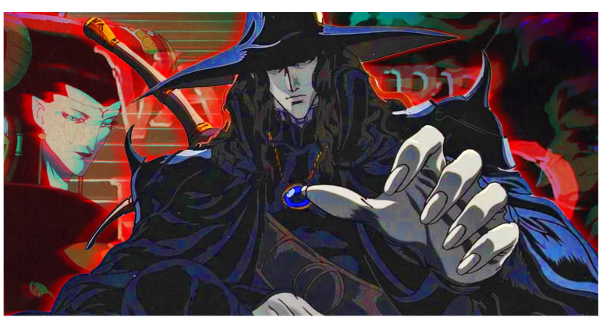
There is a face living in his left hand. A wisecracking little symbiote that talks trash and chews up whatever scene it lands in. Every so often, the little rascal saves the day by swallowing a blast of energy, a mouthful of dirt, or even a whole windstorm. On paper it reads ridiculous. In practice it works, and that smart mouth ends up being a big reason the movie doesn’t sink all the way into gloom. People have been quoting that gremlin for forty years now.
Jump a decade and a half forward and the ambition explodes. Vampire Hunter D: Bloodlust premiered at the Fantasia International Film Festival in 2000 before reaching American theaters in 2001, and brother, it’s a different animal. Yoshiaki Kawajiri, the same mind behind Ninja Scroll and Wicked City, took the helm. The man doesn’t do restraint when spectacle is on the table. Adapted from Kikuchi’s third book, Demon Deathchase, this feature trades grime for grandeur. Every frame looks painted. Character designer Yutaka Minowa builds on Amano’s haunting vision, giving the film a beauty that feels almost unreal. Shadows pool thick as ink. Light spills through cathedral windows in a way that makes you forget you’re watching animation rather than a moving gallery.
The emotion cuts a lot deeper here. A wealthy family hires our wanderer to retrieve Charlotte, their daughter, taken by a Noble named Meier Link. Simple bounty, right? Except she went willingly. She loves him. He loves her back, truly, and the chase stops being a rescue and turns into a tragedy you watch coming and can’t halt.
That is the genius move. Bloodlust asks whether the monster is actually the monster. Meier isn’t drooling over a victim. He is a being out of time trying to hold one honest thing before the dark claims it. Meanwhile a rival crew, the Marcus brothers, hunts the same prize for coin, and among their company travels Leila, the lone soul with real warmth in her chest. Her slow thaw toward the quiet swordsman, two outsiders recognizing each other, gives the picture its aching core. The moment she asks him to visit her grave someday wrecks people to this day.
The ruined keep they race toward belongs to Countess Carmilla, a legend soaked in Bathory lore, scheming to rise again through Charlotte’s veins. But getting there means surviving the deadly Barbarois warriors hired to protect Meier Link. Benge slips into shadows. Mashira becomes a monstrous werewolf. Caroline takes on deadly plantlike forms. Together they turn the journey into a gauntlet of nightmares. Kawajiri stages each clash as a music video from hell, gorgeous and vicious at once.
So which earns the crown? Depends on what you came for.
The original is comfort food for the horror head. It is a mess, and proud of it. Lurid, full of fangs, carrying the grain of an era when the medium was still testing how strange it could get away with being. The movie wants a scream, a flinch, maybe both at once. It won’t apologize for any of it. It stalks, slashes, and heaps on the body horror, basically daring you to look away first. Nobody puts it on for restraint. You put it on because some madman had the nerve to toss Dracula and Mad Max in a blender decades before the genre figured out that was even on the menu.
Bloodlust is the fancy one. Put it on for the friend who swears up and down that cartoons cannot make him feel a thing. Then the love story at its center does precisely that, aching in a way this medium almost never has the guts to try. Its visuals embarrass most of what gets called animation now. And the sadness of it just settles in your chest and refuses to leave. The 1985 one goes for your pulse. This one goes for your throat and takes its sweet time squeezing. If the earlier outing plays like a haunted carnival, the follow up plays like a requiem. It is not a continuation of the same story, but a separate adventure that finds something even more heartbreaking in the same lonely hunter.
Here is the thread tying both together, the thing that drags new folks to these movies decade after decade. It is him. The dhampir who fits nowhere.
Think about it. People fear him for the fangs he hides. Nobles can’t stand him either, put off by the human weakness in his blood. He guards the very folks who would drive a stake through him the second they figured out what he really is. And on he goes, chasing the monsters tied to his own bloodline across a dying planet, one century bleeding into the next. He doesn’t rest. The girl is never his to keep. That one place that might feel like home? Always just out of reach. That loneliness is written into his very bones, and it lands different when you have ever felt caught between two things that both reject you.
Amano’s designs make the ache visible. Those long limbs, that androgynous grace, the costume somewhere between samurai and funeral. He looks like sorrow wearing a hat. The far future around him, with its crumbling tech, feudal terror, and mutant wildlife, stays fresh because almost nobody else commits to that exact recipe. Other shows explore apocalyptic ruins. Vampire tales have been told a thousand times. This saga fuses both into one bleak, beautiful dreamscape and refuses to blink.
That is why newcomers still fall hard. That is how the old heads end up guarding their discs. You can see the influence reaching into later Castlevania games, where producer Koji Igarashi acknowledged Vampire Hunter D as one inspiration for Alucard. That blend of otherworldly beauty with deadly loneliness became part of a larger gothic tradition spanning anime and gaming. And the story is still finding new audiences. In August 2026, GKIDS announced that Bloodlust would return to North American theaters in a new HD presentation, with a wider theatrical and home entertainment release planned for 2027. More than twenty five years after its original premiere, that beautiful nightmare is getting another chance to haunt the big screen.
So if you have yet to ride out past the edge of the map with the quietest killer in the wasteland, handle that soon. Put on the grimy 1985 cut first for the jolt of it, then let Bloodlust go ahead and wreck you proper. Run them back to back and watch the art form evolve. Two different adventures built around the same haunted soul, one rowdy and raw, the other quieter, more heartbreaking.
Out there the sun is still a threat. Those old castles have not fallen. And some solitary rider is moving along that road with no end in sight, going on forever, close enough to human that it hurts.
That is the magic. That is why it lasts.
Staff Writer; Jay Baker
An older blerd with a lifelong love for anime, comics, manga, and gaming… Writing for fans who still believe great stories can come from a screen, a page, or a controller…
He can be contacted at JayBaker@AfroGamers.com.