(AfroGamers.com) Back in 2014 a goofy cosmic romp ended its very first episode by blowing up its heroes, their ship, and the planet beneath them. The credits ran over the rubble. A week later the same crew sauntered back in, hair intact and swagger somehow louder, out chasing rare aliens for pocket change like nothing had happened. That was the pitch. It was also, weirdly, the whole genius of the thing.
Shinichiro Watanabe, the mind behind Cowboy Bebop, served as chief director while Studio Bones turned the project into a playground for an unusually large collection of writers, directors, designers, and animators. The show lived on that freedom. One week you got a zombie outbreak played strictly for laughs. A few episodes later Dandy entered an intergalactic grand prix that eventually hurled him billions of years into the future. Over 26 episodes across two seasons, very little felt obligated to what came before because continuity was never allowed to put a leash on the imagination.
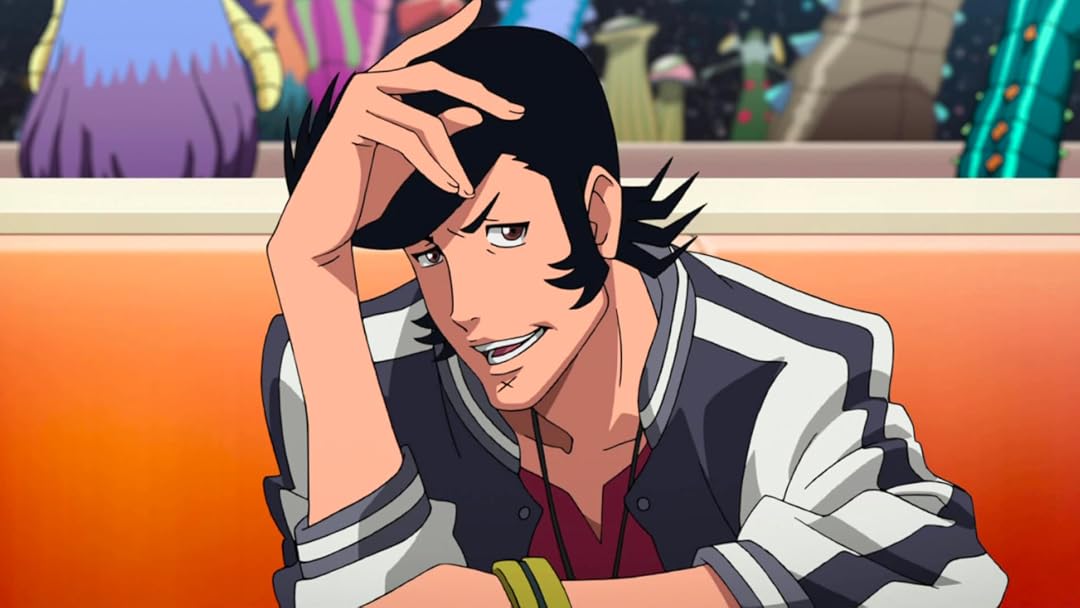
You barely need the premise, which is sort of the joke. Our guy drifts around the galaxy registering new species for cash, hauling along a cranky robot called QT and a Betelgeusian who looks a lot like a house cat and answers to Meow. The three of them inhale wings at a knockoff joint with a name that would get sued. The Gogol Empire keeps trying to capture Dandy, and the show cannot be bothered to tell you the full reason until much later. Small stakes, loud shirts, a pompadour you could see from orbit.
Variety was the flex. Inside a single stretch the show might hand you body horror, then drop Dandy onto a strange planet populated by highly evolved plants, then swing into a ridiculous high school musical parody that had no right to work as well as it did. Other episodes played with radically different visual styles, alternate dimensions, and worlds where the characters themselves could be bent into shapes that barely resembled ordinary existence. None of it needed to connect neatly. That was the point nobody argued with.
The payoff landed late, when the series finally dove headfirst into the whole alternate selves idea and nailed it precisely because it had already earned the chaos. Dandy encountered other versions of himself, QT, and Meow scattered across alternate universes, each one a shade off from the crew we knew. By the finale, the reason the Gogol Empire had been chasing him came into sharper focus. The idiot everybody had underestimated possessed extraordinary Pyonium energy, the very thing capable of bending the boundaries between dimensions. That smug narrator floating over every adventure turned out to sit a lot closer to the center of everything than you would ever guess.
So there it is. Dandy could die, planets could explode, timelines could swap, dimensions could fold in on themselves, and the next episode would just keep walking, hair unbothered. No grief counseling. No three film arc about processing the pain. Keep it moving.
That lightness was the actual power. A solid decade before alternate worlds became the industry’s comfort food, this funky little oddball treated infinity like a shrug and a punchline. Big stakes were never the aim. Dumping them was, which let the imagination run anywhere it wanted without pausing to ask permission.
Put it on now and it feels less like an old relic and more like a memo nobody answered. The culture caught up to the idea, then lost the lesson sitting under it. Endless possibility only stays fun while it stays loose. Grade every alternate universe on a rubric and you choke the very thing that made it worth watching. Our boy figured all that out while hunting a paycheck across a galaxy that could fall apart at any moment, laughing the entire way down. It’s a mystery, like he always said. Maybe just let it stay one.
Staff Writer; Jay Baker
An older blerd with a lifelong love for anime, comics, manga, and gaming… Writing for fans who still believe great stories can come from a screen, a page, or a controller…
He can be contacted at JayBaker@AfroGamers.com.