
(AfroGamers.com) Somewhere around midnight, back when the television still had a knob and a prayer, I used to catch these shows after the rest of the house finally gave up and went to sleep. Cowboy Bebop ran low so the volume wouldn’t travel down the hall. That saxophone came creeping out the speakers, and Spike Spiegel moved through it like a man who already knew the last page of his own story. No charging up for ten minutes. Nobody screaming at the clouds just to swing once. The thing breathed. And sitting there in the dark, half the time I’d notice I was breathing right along with it.
The feeling has been poking at me again lately. A lot of what comes out of Japan now shows up louder, shinier, and kinda empty in the spots the old stuff used to wreck me.
Let me be straight before anybody gets their feelings bruised. The new wave looks incredible, no argument. Studios are putting sequences on screen that would have cooked a TV set back in 1998. You watch Demon Slayer and some sequences are so pretty you stop and stare. Then Jujutsu Kaisen comes through with choreography that honestly unhooks your jaw. Craft did not fall off. Matter of fact the ceiling shot straight up.
Here’s where my worry lives, though. Somewhere along the way a chunk of the industry started confusing bigger with better, and the two were never the same cousin. Watch enough current hits and you notice the pattern. A hero gets strong. Then a villain shows up stronger. Hero digs deep, finds a gear nobody knew he had, pulls it out. And here comes somebody nastier with a bigger number stapled to his forehead, and round and round it goes till winning barely registers anymore. Dragon Ball ran that treadmill for years. Goku reaches another impossible level of power, so the writers gotta cook up somebody even stronger, then somebody stronger than that, and every fresh victory kinda erases the one before it like it never happened.
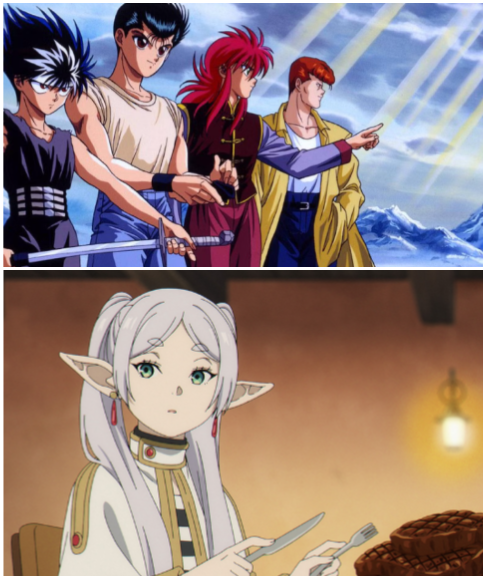
Compare that to how the old shows made you actually love somebody first. Take Yu Yu Hakusho. First episode, Yusuke Urameshi dies. A teenage knucklehead who picks fights and skips school steps into traffic to save a kid, and he gets flattened for it. What follows is not a training montage. We watch his mother fall apart. Then we feel him hovering there, realizing nobody expected much from his life anyway. By the time he earns his way back among the living, you are locked in, and not one ki blast has gone off yet. The muscle came later, sure, but it rode on top of a kid you already understood.
Trigun worked a different angle and hit just as deep. Vash the Stampede walks around like the biggest fool in the desert, gorging on donuts, dodging bar tabs, flinching from spiders. Underneath all that clowning sits a gunman good enough to settle any argument in a blink, who decided he would rather suffer than take a life. That contradiction is the entire engine. His restraint costs him. Every town he saves still looks at him sideways. Here’s a man who could end any fight before it starts, and he keeps choosing not to, and you can see what it does to him. That taught me more about guts than any screaming power up ever has.
Then there’s Inuyasha, which figured out that wanting somebody can carry a whole show on its own. Sure, there was a jewel to chase, shards scattered everywhere, the usual. Come on now. Wasn’t nobody sitting through week after week for a scavenger hunt. We stuck around for a half demon caught between two worlds that neither one wanted him in, fumbling his way toward letting a person actually get close. Kagome and Inuyasha spent ages just orbiting each other, and the orbiting was the whole thing. That ache built something no scoreboard ever could.
Cowboy Bebop, my old reliable, might be the purest proof. Think on who is even aboard that ship. A bounty hunter running from a love he cannot undo. Beside him, a woman buried in debt and ghosts. Then a kid hacker, a sharp dog, and a whole lot of silence between the jazz. A good number of episodes barely bother with a fight at all. What they chase instead is mood, and regret, and that nagging fact that your past knows your address no matter how far out you run. So when Spike finally walks toward his ending, it drops on you like gravity, ’cause the show put in every hour before it to earn that moment rather than puff him up into some demigod.
So notice what those four have in common. Their original television stories actually reached an ending. Yu Yu Hakusho wrapped up its main run, even if the franchise eventually returned with specials and adaptations. Bebop said its piece in twenty six tight episodes, though a movie and a live action version followed. The original Trigun finished its journey back in 1998 before Vash eventually rode into town again in newer productions. And Inuyasha finally brought its central story home with The Final Act, even if another generation later picked things up in Yashahime. The point was never that these worlds could not be revisited. It was that their stories had somewhere to land. An ending used to be the whole point, the thing the entire ride was aiming at. Now too many properties seem built to run till the sun burns out, every new arc straining to outshout the last, because a finished show quits printing money and a forever one keeps the merch flying off the shelf.
I get why it shook out this way. Streaming numbers, manga sales, and merchandise can all give publishers and studios reasons to keep a successful franchise alive. A fresh and scarier opponent is often the simplest lever to yank when somebody needs another big arc. The machine is doing exactly what the machine was built to do. None of that is a conspiracy. It is just incentive, grinding away.
Here’s the part that keeps my head up, though, ’cause I’m not trying to be the old man on the porch hollering that it’s all over. Thing is, some newer shows are already proving there is another way. Frieren strolled in soft spoken and pulled a massive crowd, and beneath its flashes of action gave us quiet, and grief, and a story you measure in what somebody remembers instead of how hard they punch. Vinland Saga swapped out revenge for something that cuts deeper and knows more. People are plain hungry for weight, not just sparks going off, and the money men have reason to pay attention when the slower, more soulful stuff finds an audience too.
So this was never a sermon about the past being holy and the present being junk. The craft today is astonishing, and I would not hand it back. All I’m really asking, hat in my hands, is that these shows remember what the old ones already had figured out. Make me care about the person before you turn them into a wrecking ball. Give a fight some stakes because somebody’s heart is in it, not ’cause a fatter number popped up on screen. And when a story’s run its course, let the thing end.
Flip to a station at midnight sometime and sit with one of those old joints. Keep the volume low. You will feel the difference in your chest before your head ever finds the words for it.
Staff Writer; Carl Davis
This bro has always been into gaming, anime, manga, old-school sitcoms, and just about anything connected to nerd culture. A proud Black blerd for life, CD enjoys writing about the shows, games, and characters that have stayed with him over the years.
Feel free to drop him a message at CarlD@AfroGamers.com.