
(AfroGamers.com) Two cartoons sat at the middle of what Nickelodeon meant to a whole generation, and neither worked the same corner of the imagination. One lived beneath the ocean and treated a greasy fry cook gig like grand opera. The other set up shop in the suburbs and asked a simple, dangerous question: what happens when a neglected boy gets handed wish-granting magic? Line them up and the personality of the channel comes into focus, split clean down the middle.
A marine biologist named Stephen Hillenburg cooked up SpongeBob, and it hit screens in 1999. Bikini Bottom just flat out refuses to follow normal rules, and nobody living there seems the least bit bothered. Fire burns fine underwater. Sandy the squirrel walks around in a diving suit and everybody treats it like ordinary Tuesday business. None of it makes a lick of sense, which was the whole idea. Hillenburg spent real years studying the ocean before he ever picked up a pencil, and you can tell. His made up sea somehow feels lived in.
What sneaks up on you is how much of the comedy grows out of work. Half the show plays out at a fast food counter. You’ve got a boss so cheap he’d charge you rent on the air near his register. His star employee, though, treats flipping burgers like a calling, which drives their coworker Squidward slowly out of his mind. Meanwhile the competition is a guy the size of a thumbtack, dead certain that one stolen recipe stands between him and the life he deserves. Take away the water and it’s just people worn down by work, chasing things, putting up with folks they never chose. Adults heard those jokes one way. The young ones heard them another. That second layer is a big chunk of why the thing lasted.
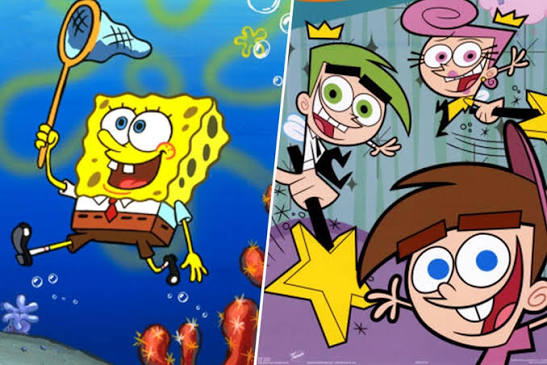
Now flip the channel in your memory to Dimmsdale.
The Fairly OddParents came from Butch Hartman, and there’s a wrinkle worth noting. The kid actually reached the screen before SpongeBob did. His scrappy shorts turned up on Oh Yeah! Cartoons back in 1998, a full year ahead of Bikini Bottom opening its doors, though he wouldn’t claim his own half hour slot until 2001. Timmy Turner is ten, ignored by parents who love him in a distracted sort of way, and terrorized by a red haired babysitter named Vicky who rules his house like a warden. Into that gap float Cosmo and Wanda, magical guardians who grant almost any desire the boy can dream up.
Where the sponge’s saga mines the grind of adulthood, Turner’s tale lives entirely inside the fantasy of being small and powerless. Every episode is a pressure valve for childhood frustration. Bad grade? Wish it away. Bully getting loud? Poof, problem solved. The genius sits in the catch. There’s a rulebook, Da Rules, and it exists purely to make sure each wish curdles into a mess. You cannot manufacture true love. Fairies cannot directly maim or kill people. And whatever the kid conjures always spirals into a lesson he’d rather skip.
That structure tells you everything about the split. One cartoon asks you to laugh at the absurd machinery of the working world. The other hands you the keys to omnipotence, then quietly teaches you why unchecked wanting rarely ends clean. Both are moral in their bones. They just preach from opposite pulpits.
Look at the texture, too. Hillenburg’s ocean is soft and painterly, a little grimy, alive with strange organic shapes and a jazz and sea shanty soundtrack that feels older than the audience. Hartman’s Dimmsdale is sharp, flat, loud, built from bold outlines and primary colors, humming with the frantic buzz of a grade schooler bouncing off the walls after too much cereal. You could mute either and still know which universe you’d wandered into inside three seconds.
Even the pacing splits them. Bikini Bottom often slows down and marinates in a single stupid moment until it becomes hypnotic. That famous shot of the sponge scrubbing while the narrator drones about time passing? Pure patience as a punchline. Dimmsdale, by contrast, sprints. Setup, wish, catastrophe, reset, all before you can catch your breath. Hartman built a machine for velocity. The marine biologist built a mood.
This is where I tip my hat to what the network was pulling off back then. Early 2000s Nick wasn’t chasing a single flavor of funny. It was betting on range. You could roll out of bed and watch a fry cook find spiritual meaning in a spatula, then turn around an hour later and see a lonely ten year old accidentally destroy his town with a careless thought. Neither approach apologized for itself or tried to mimic its rival.
That confidence mattered. A lot of channels pick a lane and flog it into the ground. Nick, in its prime, understood that being young contains multitudes. Little ones are surreal philosophers, then turn into raw balls of want a breath later. The biologist spoke to the first mode. The animator spoke to the second. Put them side by side and you’ve pretty much got the whole feeling of being a kid, back when the adults ran everything and mostly missed whatever was rattling around in your head.
Both franchises got milked long past the point they should have quit, and the reason is plain enough. When something taps a real vein, executives keep drilling long after the well goes dry. Purists argue the fry cook lost his soul after his creator first stepped back, and plenty of folks felt Turner’s adventures overstayed their welcome too. Fair criticism, all of it. Still, go back to those first few seasons of either one and they hold up. Two cartoons chasing totally opposite notions of what counts as funny, parked under the same roof, both landing. That is not nothing.
I catch myself missing that whenever I sit through a lot of what’s out now. Too much of it feels ground down into mush, scared to pick a lane or say anything with a pulse behind it. Back then two very different minds were handed room to be strange in their own directions, and Nick had the nerve to platform both without forcing them to rhyme. The undersea tale dug into adult drudgery through the eyes of a creature too pure to notice how bleak his gig really is. Timmy’s world, meanwhile, mapped the fantasy of childhood escape and gently reminded us that getting everything you want is its own kind of trap.
Neither is better. That was never the question worth asking. They’re two answers to the same riddle of how you make a kid laugh while slipping something real under the door. Put a fry cook at one end and a starry eyed boy at the far side, and you’ve drawn the full width of what that beloved network could be when it trusted its own imagination.
And honestly? Both of them still hit. Throw on an old episode of either and watch how fast the years fall off your shoulders. That’s the mark of the good stuff. It waits for you, patient as the tide, ready to pull you right back under.
Staff Writer; Greg Tucker
GT is an old-school blerd who loves anime, comics, manga, video games, and collecting indie Black comic books.
Contact him at: GregT@AfroGamers.com.