
(AfroGamers.com) Some anime grabs you by the collar inside the first five minutes. Big explosions, rising power levels, a kid hollering an attack name while the sky splits open. That style is a blast, and I came up on it. Every so often, though, a title leans close and murmurs instead of yelling, and Witch Hunter Robin is one of those sneaky gems that trusts you to meet it halfway.
Sunrise put this out in 2002, and a whole lot of heads slept on it. You get twenty-six episodes with no glowing transformations and no tournament bracket. What sits in their place is atmosphere. Taku Iwasaki scored it with strings, horns, and a smoky church organ dread that hangs over each scene like haze in a late-night jazz room. Shukou Murase ran the direction with the calm of somebody who knows a strong story never has to sprint.
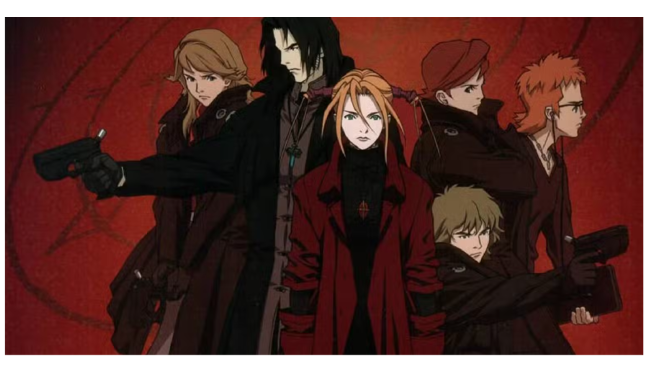
Peep the setup. A fifteen-year-old named Robin Sena arrives in Japan from Italy, raised inside a convent, carrying the ability to ignite targets with her mind and grief behind a flat stare. The girl joins STN-J, a secretive Japanese unit that tracks down witches whose supernatural abilities have made them dangerous in the eyes of the organization. Some members of the team offer a measure of kindness, while others keep their distance. Amon, in particular, makes it clear that trust isn’t something a newcomer gets handed on arrival. That uneasy reception tells you plenty about this world before the real trouble even begins.
I won’t front about why people drop it early. The hesitation is fair. Its pacing asks for patience. Those early chapters move almost like case reports: a gifted person snaps, the squad investigates, somebody ends up hauled away to a cold site called the Factory. Then the cycle runs again. If you clicked play hungry for Dragon Ball voltage, you’ll check out by the fourth episode and miss the entire reason it exists.
The reward hides in its slow unfolding. Somewhere near the middle the floor gives way beneath you. What posed as a monster-of-the-week procedural twists into something sadder and far more political, a meditation on who gets stamped as a danger and who holds the stamp. Our lead stops being the fresh hire and turns into prey. The agency she leaned on bares its fangs. Through all of it, nobody ever raises their voice to announce that a big moment arrived. Tension simply piles up, quiet and heavy, until you notice you’ve been holding your breath.
Sit with that premise long enough and it starts to itch in a familiar way. People born different, tracked by an institution, sorted into useful or disposable, hunted by the same system that claims to protect the public. Black folks reading between those lines won’t need the subtext spelled out. The show never preaches it, which is exactly why it lands. Fear of the other, dressed in trench coats and protective pendants, is still fear of the other. A cartoon said plenty about power and paranoia without ever reaching for a soapbox.
Sena herself anchors the whole mood. The girl isn’t a screamer or a one-liner machine. Robin watches everything, patient and sharp, revealing more through her silence than most characters manage with words. When she finally acts, it hits twice as hard because you sat in the stillness first. In an era when so many anime leads announce every feeling the second it arrives, a hunter who keeps her cards close to her chest feels almost rebellious. That restrained energy is the point of the character. Hand this role a motor mouth and fireworks, and the spell snaps clean in half.
Can we rap about Amon for a second? Sena’s partner spends most of the run wrapped in black, jaw set, eyes doing the talking. Whatever runs between those two never blows up into a big romance beat or a shouting match about trust. It just sits there, in the looks they trade and the long stretches where neither one says a word on some late drive across town. A modern writer might cram in flashbacks and a tearful speech to spell it all out. Murase trusts you to feel it without the footnotes, and that is why it sticks.
Can’t skip the way it looks either. Trench coats and washed-out grays, streets always a little wet, and those small pendants carrying green Orbo liquid, designed to help protect hunters from supernatural attacks. Everything feels pulled from a detective paperback that wandered into a cathedral. Blerds who caught it during those late-night Adult Swim runs know the vibe I’m painting: you half expected a saxophone to start wailing while somebody sparked a smoke in the dark. Few shows from that era committed to such a feeling and stayed loyal to it from start to finish.
Does it stumble? Sure. A couple of midseason chapters spin their wheels, and the finale leaves threads dangling that a second season never came to tie. Some viewers will always call it too chilly, too withdrawn, too slow for their blood. That’s a fair gripe. Art built on restraint asks something of you, and not everybody arrives ready to give it.
Here’s my whole argument, laid flat. Not every anime needs to pop off every eight seconds to earn your respect. There is so much spectacle out there now, and don’t get me wrong, I will throw on a good fight scene any day of the week. The thing is, flash by itself leaves you hungry an hour later. A story that makes you sit up and actually wrestle with something uncomfortable accomplishes what spectacle alone rarely manages. This one bets everything on patience and comes out richer for the wager.
Funny thing is, the culture finally caught up to that kind of patience. People binge moody prestige television now and call deliberate pacing sophisticated. Put the same energy in a 2002 anime and half the fandom still writes it off as dull. The double standard always cracked me up. Give this series the same grace you hand a slow crime drama and it pays you back the exact same way, with dread that earns its keep and payoffs you actually feel.
Still, more than twenty years later, this one aged like good vinyl. While noisy franchises blur together in memory, a slow burner like this carves out its own lane. Go back and let it simmer. Watch Sena move through smoke and sorrow with her chin level and the fire banked. Feel the quiet tighten one notch at a time. You might walk away convinced, same as me, that the stillest head in the room was holding the sharpest blade the entire time.
Staff Writer; Greg Tucker
GT is an old-school blerd who loves anime, comics, manga, video games, and collecting indie Black comic books.
Contact him at: GregT@AfroGamers.com.