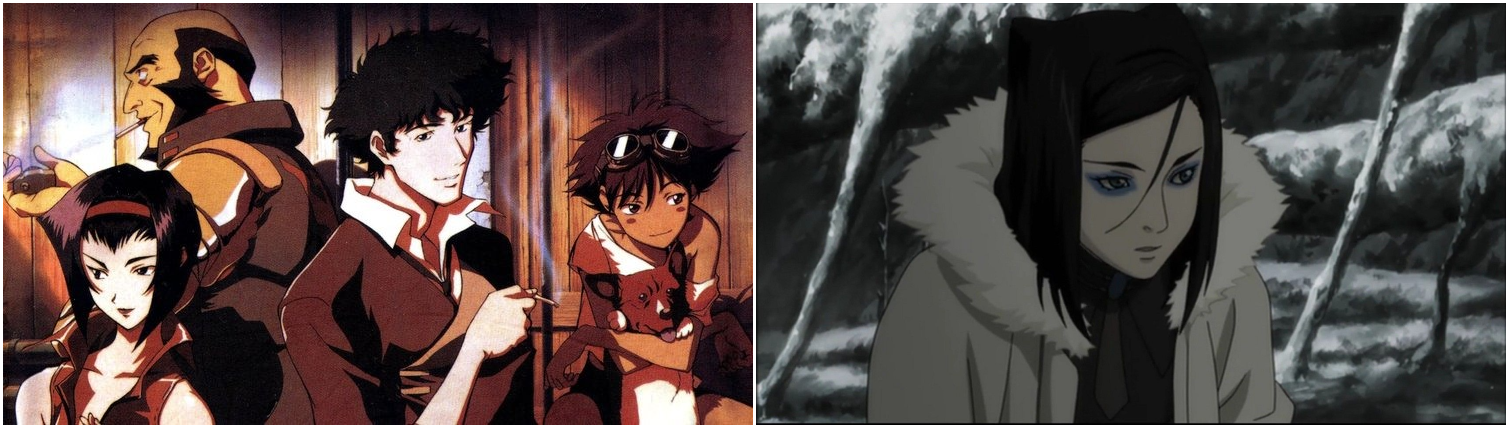
(AfroGamers.com) Back when I was coming up, the future actually had a shape to it. You could see it. Neo-Tokyo lit orange and tearing itself apart under a swollen sky, for starters. Then a cyborg woman steps off a high rise into neon and rain like gravity means nothing to her. Or Spike Spiegel, broke and cool, drifting through the solar system while a saxophone cried behind him. All of that crawled into a young Black kid who stayed up way past his bedtime for Toonami and Adult Swim. It got me asking things. None of them about elves. They were about us, and about where we were all going.
Katsuhiro Otomo put out Akira in 1988 and pretty much wrote the book on animated dread. He set it in a Neo-Tokyo raised up on the ashes of a city a catastrophic explosion had erased, so Japan’s whole nuclear nightmare sat right there in the backdrop. The story kept poking the same ugly nerve. What happens once our reach gets way out ahead of our judgment? Mamoru Oshii turned up seven years behind him with Ghost in the Shell in 1995, and his Major Kusanagi spent the runtime unsure whether any soul was still left inside a mass-produced body wired into the net. Think about the timing on that. Regular folks were out here cussing at a dial up modem, while this movie already had its teeth in what your online self amounts to, whether a hacked memory still belongs to you, where the human ends and the code kicks in.
That was the assignment back then. Look forward. Cowboy Bebop, Serial Experiments Lain, Steins;Gate, Ergo Proxy, Evangelion. Even the giant robot joints carried heft, because the machine always doubled as a question about the boy strapped inside it. These stories chewed on cities and circuits and deep space and the bomb. They treated what’s coming like a place worth fighting over.
Now flip on a seasonal lineup and count how many series open with some tired office worker getting flattened by a truck.
Truck-kun, the fanbase calls him. Patron saint of the reset button. He rolls up, does his job, and our hero wakes reincarnated in a swords and sorcery realm holding cheat-level abilities, a swelling crowd of adoring companions, and a demon lord to slap around. This is isekai, “another world” in Japanese, and across the last decade it went from a rare novelty to the beast devouring the schedule whole.
Look at the count and it gets silly. One industry analysis found that for something like two decades the genre barely showed up, maybe zero to four new titles in a given year. It hit fourteen by 2019, dropped back to eight in pandemic-hit 2020, and after that the thing just went nuts. Twenty six in 2021, twenty three a year later, thirty three by 2023. Then a fat thirty four in 2024, the year this other world stuff swelled into roughly fifteen percent of all the fresh television anime Japan put out. Sit with this one. More than half of every otherworld title counted in that analysis arrived after 2020. Not stacked up over four patient decades. Dumped on us inside a handful of years.
Why? Follow the money, same as it ever was. Making original animation is pricey and flat out scary for the people signing checks. So studios and publishers keep returning to a content mine that already proved it could build an audience. Amateurs post serialized stories on a site called Shosetsuka ni Narou, or Let’s Become a Novelist, where popular works can arrive with readers already waiting. Publishers scoop up the ones that catch fire, turn them into light novels and manga, and some eventually make the jump to animation. By 2026, more than 200 anime projects had come from works posted on Narou alone. KADOKAWA itself later admitted the business had leaned too hard on familiar winners, pointing to a bias toward Narou and isekai properties that helped create market saturation and left less room for originality.
Then wrap the business case in something warmer. These shows peddle comfort. The lead is usually a burnout, a shut in, a kid who got stepped on, somebody life forgot. He dies ordinary and wakes chosen. No shock that grinding adults eat it up, especially during lockdown stretches when everybody wanted a soft spot to duck into. I get the pull. Honestly. Ain’t nothing wrong with a warm blanket after a brutal week.
But here comes my gripe, and it is a Blerd gripe to the core.
The old masters used their craft to squint hard at what waits ahead and warn us. This new wave mostly uses it to bounce. One lineage asked where humanity is headed. The other asks how quick can I ditch this planet for a pretend realm where I finally stand as the baddest cat in the room.
Not every last drop of it is hollow, mind you. Mushoku Tensei caught real smoke for its main character early, yet it earned respect from plenty of viewers for actually letting a broken man grow up. Re:Zero runs its lead through a meat grinder of trauma and fallout. Every so often somebody bends the familiar frame toward something true. Make believe was never the villain either. The atomic dread of those classics was its own flavor of flight, and the mecha stuff always packed a little wish fulfillment. Nobody is pretending the golden age was spotless.
The rub is sheer volume. When a single lane swallows around fifteen percent of everything, the neighboring lanes start fighting harder for room. High concept science fiction slowed to a drip while the reincarnation assembly belt ran three shifts a day. Where is this generation’s Ghost in the Shell, wrestling with what synthetic minds mean now that we went and actually built them? Right now we are living smack inside the questions those elder films only dreamed. The face scanners are already watching. Chatbots fake a soul convincingly enough to spook your grandma. And the fight over what a body even is anymore runs hot every day. The moment is begging for bold speculative storytelling, and a giant slab of the business answered by mailing everybody to fantasy medieval Europe with a floating status screen attached.
Maybe the tide turns. Fans have been grumbling louder about the same tale showing up on loop, and even major industry players have admitted that leaning too hard on familiar formulas can squeeze the life out of originality. Better still, Science SARU brought Ghost in the Shell back to television in July, becoming the first studio other than Production I.G to animate a Ghost in the Shell series across the franchise’s roughly three decades on screen. The old dog got let off the porch again, which tells you somebody upstairs still trusts that a hard look at what’s coming can move units.
I hope they are right. Because this art form handed me my earliest vision of what might be waiting for all of us, ugly and dazzling and painfully human. It taught a kid on the couch to lift his eyes and look outward. I would love the next kid to get more than a truck, a cheat code, and a one way ticket clean out of reality. Hand them a mirror aimed at the horizon instead. That is what this whole thing was made to do.
Staff Writer; Carl Davis
This bro has always been into gaming, anime, manga, old-school sitcoms, and just about anything connected to nerd culture. A proud Black blerd for life, CD enjoys writing about the shows, games, and characters that have stayed with him over the years.
Feel free to drop him a message at CarlD@AfroGamers.com.