
(AfroGamers.com) Some anime arrives when the culture wants something loud and bright, then quietly declines to hand it over. Wolf’s Rain was that kind of trickster. It came out in the early 2000s while the boom was roaring, back when a cable box and a late bedtime felt like a passport, when Adult Swim taught a whole generation of us that a cartoon could carry more weight than most of what aired in prime time. We were flying. Then this odd creature strolled in wearing frost and hush, unsettling folks in a way they struggled to put into words.
I caught it as a teenager, half expecting the usual adrenaline. Big fights, a rival with a smirk, maybe a tournament arc to keep the blood pumping. What greeted me instead was a frozen city choking on its own rot, with nobles controlling what comfort remained while everybody beneath them starved in the gray. Four animals wandered that ruin, passing for young men, following a rumor that a kinder place waited out past the wreckage. Nobody told me going in the road ahead would sit this heavy.
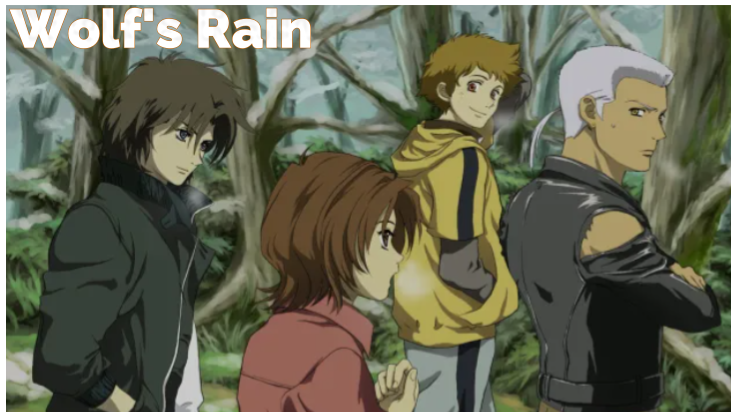
Bones produced it in 2003, with Keiko Nobumoto creating and writing the story, Tensai Okamura directing, and Yoko Kanno composing the score. That last name matters. Kanno had already blessed Cowboy Bebop, and folks who know, know. Her music here does the dirty work quietly. The melodies are gorgeous enough to lower your guard, and that is exactly when the story reaches in and hurts you.
Its premise alone signals the mood. Legend claims wolves were hunted to extinction nearly two centuries earlier. They were not. Instead they learned to cast illusions that made human eyes see young men rather than animals, hiding among people who feared them and hunted the old bloodline out of pure superstition. So right away you have got creatures pretending to be something they are not just to breathe another day, which, if you grew up Black in America, taps a nerve you were not ready for on a Saturday night. Masking to move safely through a place that wants you gone is not exactly fantasy to some of us.
Kiba leads with a stubborn faith that borders on delusion. He believes in Paradise with a preacher’s certainty, sure the promised land is real and waiting past all that cold. Tsume runs the other direction, loud and defensive, hiding how much he actually feels under the attitude. Hige floats by on charm and appetite, sitting on a secret of his own. Toboe is the baby, sweet and starving for affection, the one whose innocence you keep praying the writers will spare. Blue begins on the other side of the hunt, raised as Quent’s loyal dog, before discovering the wolf blood inside her and becoming torn between what she is and what she was taught to be. Her piece of this might hurt worse than anybody’s.
None of them are having a good time. That right there is what threw people. We came up on champions who won, who leveled up, who stood in the wreckage grinning. This group just keeps losing. Warmth slips away. Companions slip away. Even the thin hope that keeps their legs moving north begins to fade, and the story never once apologizes for any of it.
Cheza is the Flower Maiden, a girl created from the Lunar Flower itself, gentle and eerie and central to the prophecy binding everything together. She smells like home to the four, and her presence turns the chase into an act closer to worship. Darcia, a fallen noble, wants her too, though his reasons drip with mourning over a love he could not rescue. Everybody in this tale reaches for a prize already sliding through their fingers. There sits the spiritual thread humming underneath. Salvation demands everything, and the bill gets paid whether you feel prepared or not.
The land itself is dying, and the craft wants you to register every inch of that decline. Snow buries whatever used to breathe. Metropolises rust into skeletons. Even the sky looks worn out. Somebody pulled most of the color out of every shot, so you are left with gray and a washed blue that just sits on you. Nothing feels temporary about the rot. Set that against whatever else aired on the same Adult Swim block and you grasp the whiplash. One evening you vibe to space bounty hunters, the next you sit watching a planet exhale its final breath while four lonely souls trudge toward a heaven that may never open.
Then comes the finale. The complete ending arrives through four OVA episodes released after the original television run, so anybody stopping at episode 26 has not actually reached the destination. I will not spoil how it all lands, but I will tell you the finale gives you no easy way out. It loops back on itself in a way that stings, suggesting the end and the beginning were never that far apart. You reach the last frame and simply sit. No fist pump, no triumphant swell letting you off the hook. Just stillness, and the deep hurt of having witnessed something honest about grief.
Here is the reason its early success never grew into the lasting cultural ubiquity enjoyed by some of its neighbors on the block. The boom rewarded spectacle. It rewarded titles you could quote, cosplay, and meme before anybody regularly used that word. Volume beat silence almost every round. Wolf’s Rain sold well and earned real praise at the time, so this was never a case of nobody noticing. The mystery is why that initial attention never hardened into the permanent recognition granted to other Adult Swim staples. A show this heavy asks you to marinate in sorrow with zero promise of relief, and plenty of viewers back then simply were not built for the ask yet. We craved escape. Wolf’s Rain handed us a mirror instead, and mirrors are tough to love at fifteen.
Yet time has a habit of separating the real from the disposable. Those who stuck around walked away marked. There is a specific breed of fan who carries this one forever, who catches a few bars of that soundtrack and gets misty two decades later. For a lot of us in the culture, especially the heads drawn to the lonely and the profound, it became a private treasure. Not the property you scream about in a group chat. The one you mention low, almost careful, testing whether the other person recognizes the name. How people lower their voice about it says more than a marketing push ever would.
That, to me, is the beauty of it now. The show was too heavy for the era that produced it, and strangely that is the reason it stuck around. Hype burns off. What lingers is grief that felt real, and this show had it in spades. A story brave enough to march you through a collapsing world, let its characters stay scared and human under all that fur, and close on a note that actually hurts, that stays with people long after the loud stuff gets forgotten.
We were kids chasing thrills when it found us. Some of us were not ready. The ones who were got handed something rare, a piece of animation with the nerve to go quiet, to grieve out loud, to trust that a young audience raised on noise might still know truth when it finally sat still in front of them.
Staff Writer; Carl Davis
This bro has always been into gaming, anime, manga, old-school sitcoms, and just about anything connected to nerd culture. A proud Black blerd for life, CD enjoys writing about the shows, games, and characters that have stayed with him over the years.
Feel free to drop him a message at CarlD@AfroGamers.com.