
(AfroGamers.com) In the late -1940s, during the Golden Age of Comics, there weren’t many Black characters of note. Those who were there were primarily sidekicks to more established comic book characters or featured in funnies, comedy characters.
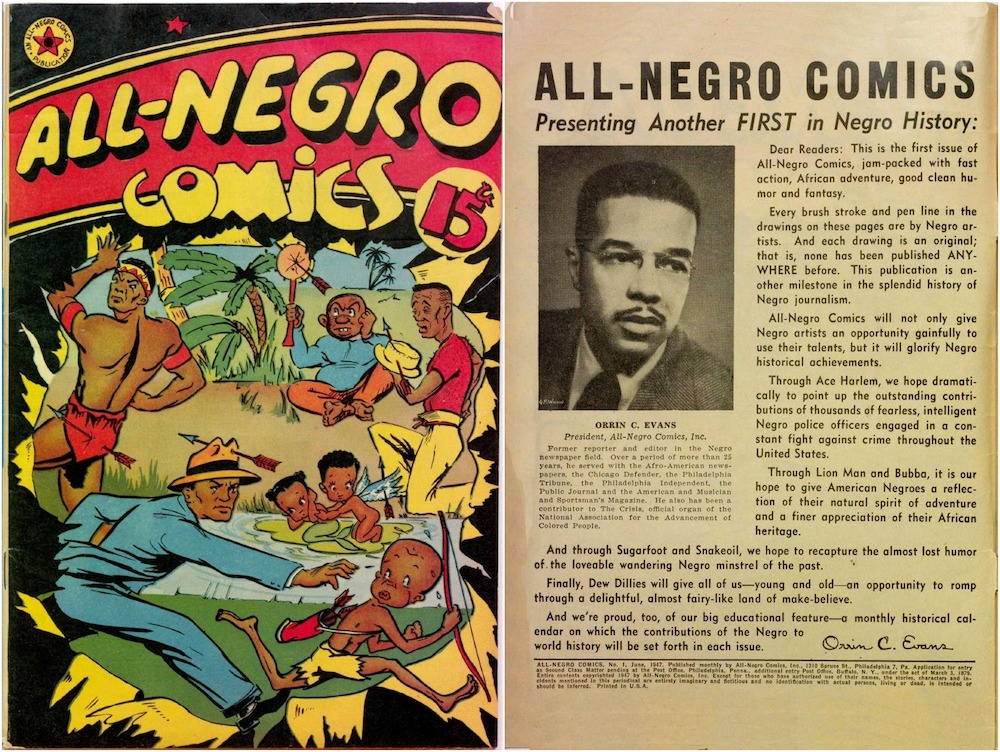
Roughly eight years ago, we covered the sole issue of the anthology All-Negro Comics. Released in 1947, it featured seven comics handled by All-Negro Comics’ team of Black writers and artists. To be honest, the only remarkable thing about the comic is that it is a Black first in publication.
However, there is one story in those pages that was salvageable. Well, let’s say one-and-a-half. Let’s look at the stories “Ace Harlem” and “Lion Man”.
The Usual Loop of a Golden Age Comic
The antagonist typically had some scheme or committed some crime in any given issue. Our protagonist either investigated the situation before encountering their foe or they just so happened to know exactly where to go to confront them.
We can’t forget the protagonist either being able to escape any trap or having the luck to do so. If the antagonist was captured and meant to be a reoccurring character, they either escaped capture after their plot was foiled or just escaped prison.
Layered storytelling or even just backstory into the major characters involved didn’t become industry standard until the late-1960s or early-1970s when we’d see more multi-part stories, story arcs, and events. You know, the stuff that lays the foundation for a comics universe.
This was the same issue with Ace Harlem and Lion Man.
Lion Man
Of the two, “Lion Man” is the half of a story that was salvageable. By salvageable, I mean that it could’ve gone further with more tales, characters, and character development. It was very much an episodic comic but as mentioned, the majority of the dedicated comics from larger publishers were very “villainous act of the issue”.
In All-Negro Comics, Lion Man is an intelligent ambassador of sorts for the United Nations. Now, it’s briefly explained how and why he was sent to Africa to protect some uranium but there could’ve been more backstory here.
This guy had collegiate or professional-level athleticism and a college education, so he’s a good pick for a powerless superhero but for him to be a pick to go protect uranium for the UN means there’s something more there. Also, he went alone. The UN can rally a peacekeeping force to provide some backup to Lion Man or something.
Then again, his main threat in the issue were resource thieves which he handled readily with his martial arts. He definitely pieces these guys up solo. He must have had quite the background but we wouldn’t know. He’s just a pre-cooked badass.
Salvaging the Uranium Warden
The best way to expand upon “Lion Man” is just to provide some lore to this guy and give him a regular foe. An organization that traffics in multiple crimes in the country or throughout the continent. Even easier, just give Lion Man similar situations and adventures as the titular character in Lee Falk’s The Phantom.
I mean, Lion Man was basically The Phantom but leaned more Tarzan. Throughout the 1950s and 1960s, “Lion Man” could’ve gotten by with just that storyline loop without that much lore and world building.
Plus, like many heroes who were around during the Silver Age, he would have enough prior adventures and character to retcon and build upon for future audiences.
Ace Harlem
“Ace Harlem” was my favorite comic in All-Negro Comics. It was definitely a product of the Golden Age approach to writing but I love pulp and detective comics and comics such as Dick Tracy, The Spirit, and Black Mask. Since detective stories like this tend to lend themselves to more storytelling even during this period, I’d say this is an easier comic to salvage.
The titular character was a private investigator with what I figure is a boxing background. You couldn’t be a private detective without some martial arts background or being a marksman with handguns. You’ll need more than observation and deductive reasoning, here.
These crime fighters were often dealing with masterminds with violent streaks or criminal groups and their main opposition were Golden Age cops. In the comics, they were still patrolling by foot and largely ineffective outside of chatting outside of the deli and putting goons in the police wagon.
They needed either private eyes who were on a case that happened to involve this criminal the cops were getting slammed by or a masked vigilante who happens to have investigation skills.
Certainly there were comics with heroic, able police officers from this period but even then, that was often one exceptional cop who always made the collar. The rest of that department was mid at best while Officer Hero stopped bank robbers…with a service revolver 1 v 4…with no harmed or killed hostages. All money returned.
Officer Hero gets a medal and the chief is happy.
Salvaging Ace
No, these cops needed Ace Harlem to solve a crime they probably wouldn’t have actually bothered with. These weren’t exactly cops from the community. Harlem was just on good terms with them in this instance.
The “Ace Harlem” story could’ve easily been expanded with a couple of multi-part cases. Some private work that has ties to the larger criminal underworld in the community (or beyond). Then tie in a big, underworld-civilian world-altering event. Very basic stuff but it gives lore and continuity to the series.
Like “Lion Man”, it would exist at a time where a chain of one-off, “Crime doesn’t pay” cases would suffice. However, I see something in the Ace Harlem character for a comic strip or just ongoing short stories.
It would be an interesting take on the pulp detective given the period in time. It’s post-Renaissance and pre-Civil Rights movement and immediately post-war.
If you’re wondering about the other stories in All-Negro Comics and how they could be salvaged or revived: those stories aren’t particularly good or interesting .
They probably wouldn’t have made it out of 1947. I know the stories included were meant to be a little something for everyone but the everything else just seemed like cutting room floor funnies.
If you’ve read All-Negro Comics, what were the stories that stood out to you? Haven’t read it? The sole issue is available on the Internet Archive and the Digital Comic Museum free to read online.
Staff Writer; M. Swift
This talented writer is also a podcast host, and comic book fan who loves all things old school. One may also find him on Twitter at; metalswift.